
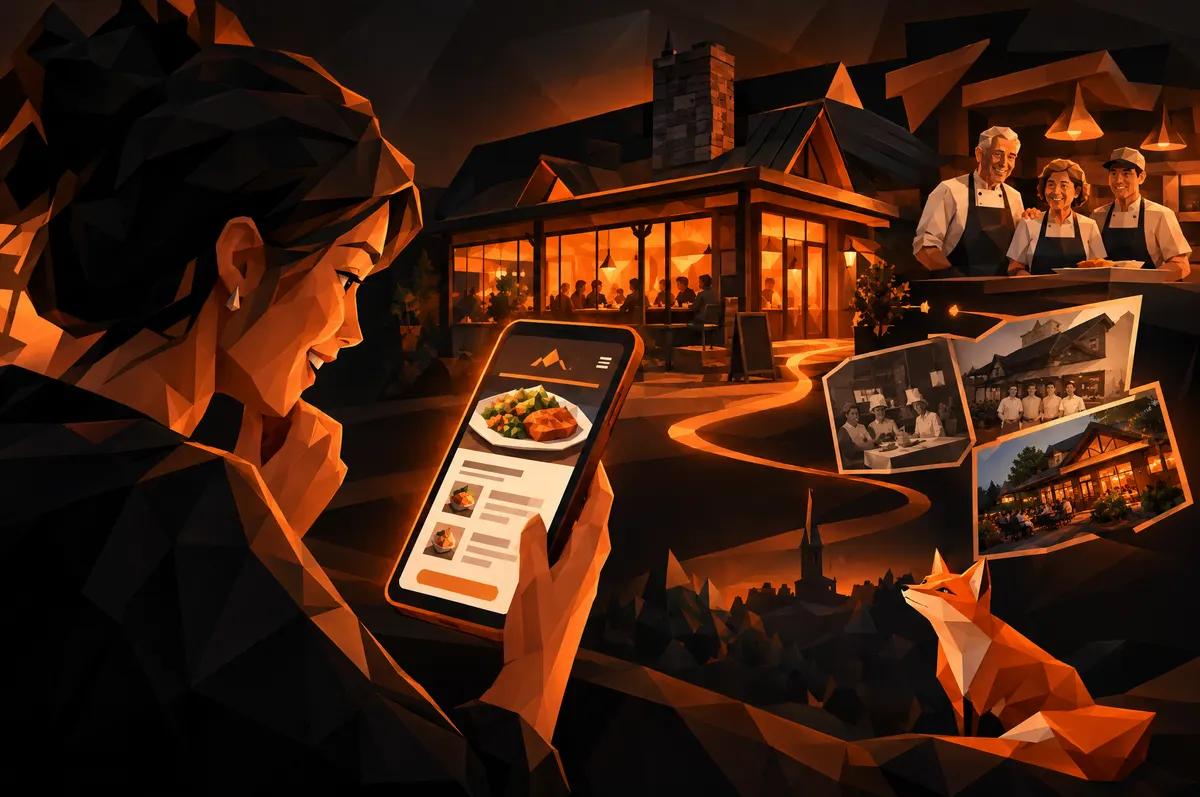
You have been serving the same neighborhood for decades. People know your name. So the website should take care of itself, right?
It does not. Here is how a website for a family owned restaurant should work, using a downtown Wake Forest institution as the example.
Why does a 25-year reputation not guarantee a diner finds you?
Reputation gets people talking about you. It does not get them through your front door on a Friday night.
Someone standing on a sidewalk downtown is not thinking about your history. They are thinking about dinner. They pull out a phone, search, and pick the first place that answers them.
Twenty-five years in downtown Wake Forest earned Las Mas Mexican Kitchen & Bar a real reputation. But a reputation does not survive a website people cannot use on a phone while deciding where to eat.
That was the starting point for the Las Mas project. The history was an asset. The site had to stop getting in its way.
What does a hungry visitor on a phone need within one tap?
Three things. The menu, the hours, and the address.
That is the whole list. Everything else on your homepage is competing with those three.
Here is the test. Open your site on your phone, on a screen deep inside it, not the homepage. Can you reach the menu, the hours and the address with one tap? If you have to scroll back to the top, hunt for a hamburger icon, or pinch to zoom a PDF, you are asking a hungry person to work.
On the Las Mas site, we kept those three within one tap of every screen. Not just the homepage. Every screen. A visitor who lands on any page, from any search, can get to what they came for.
Why do diners open a delivery app when your site is slow?
Because the app is always fast, and it always has a menu.
When your site stalls, the diner does not wait politely. They back out and open the app they already have installed. You may still get the order, but you will pay a fee for it. Worse, you might lose it to the restaurant listed next to you.
The brief for Las Mas put it plainly: anything slower than seconds and diners open a delivery app instead.
Speed is not a developer vanity project. It is the difference between a table and a missed table. Heavy images, bloated scripts and menus locked in large PDFs are the usual culprits.
You can check where you stand in a minute with our free speed test.
How do you let food photography do the selling instead of adjectives?
"Authentic." "Mouthwatering." "Made with love." Every restaurant says these. Nobody believes them.
A photo of the actual plate, well lit, close enough to see the char, does more in a glance than a paragraph of praise.
For Las Mas, we designed appetite-forward layouts where the photography does the selling rather than the adjectives. Here is what that means in practice:
- Big, honest images of real dishes, given room to breathe
- Short copy that names the dish and what is in it
- Photos sized and loaded so they do not drag the page down
That last point matters. Great photography on a slow page is just a slow page. The images and the speed have to be planned together.
Where should the family story go if not an about page?
Almost nobody visits an about page when they are hungry. They visit the menu, the hours and the map.
So if your family story lives on one page that no one opens, it is doing nothing for you. You spent twenty-five years earning it. It deserves an audience.
The Las Mas site wove the twenty-five-year family story through the site instead of quarantining it on an about page. The history shows up where diners already are.
This is the position we would take for any long-running restaurant: the story is not a destination. It is a thread. Pull it through the pages people actually visit, in small doses, and it gets read.
How do you weave history into the menu, hours and location pages?
Small touches, placed with care. The rule is that history never blocks the task.
A few ways this can work on a page:
- Menu: a short note beside a dish that has been on the table for decades, or the story of why a recipe stayed the same
- Hours: a line near the schedule about who is usually behind the counter or what the family opens the doors for each day
- Location: a sentence about how long you have been on that block, right next to the directions
Keep each one to a sentence or two. The diner gets the address first and the story second, as a bonus rather than a toll booth.
Done well, the reader never feels they are reading "history." They feel like they know the place before they arrive. That is what a family restaurant has that a chain cannot copy.
What local search and mobile habits drive walk-in traffic downtown?
Downtown walk-in traffic starts with a search from the street. Someone types the kind of food they want, or the town name, and looks at what comes back.
For a restaurant, that means your listing, your hours and your address need to be consistent and easy to find. Your site needs to confirm them quickly, on a phone, without friction.
On Las Mas, we optimized for the local search and mobile behavior that drives walk-in traffic to a downtown restaurant. That is local SEO paired with a site built for thumbs.
If your restaurant sits in a walkable town center, this is your best customer. They are close, they are hungry, and they decide fast. Our Wake Forest web development page covers how we work with businesses in town.
What should an established restaurant fix first this month?
Start with the path from search to menu. It is the part that makes you money.
- Load your site on a phone using mobile data, not office Wi-Fi.
- Count the taps from any page to the menu, hours and address. Aim for one.
- Look at your photos. Replace stock images and adjectives with real dishes.
- Move one sentence of family history onto the menu, hours or location page.
Then do the speed check. Run your address through the speed test and see what a diner on a phone actually sees.
If you want to see how the whole approach fits together, the restaurant website design page lays it out. Your next step, though, is smaller. Pull out your phone and try to find your own menu.