
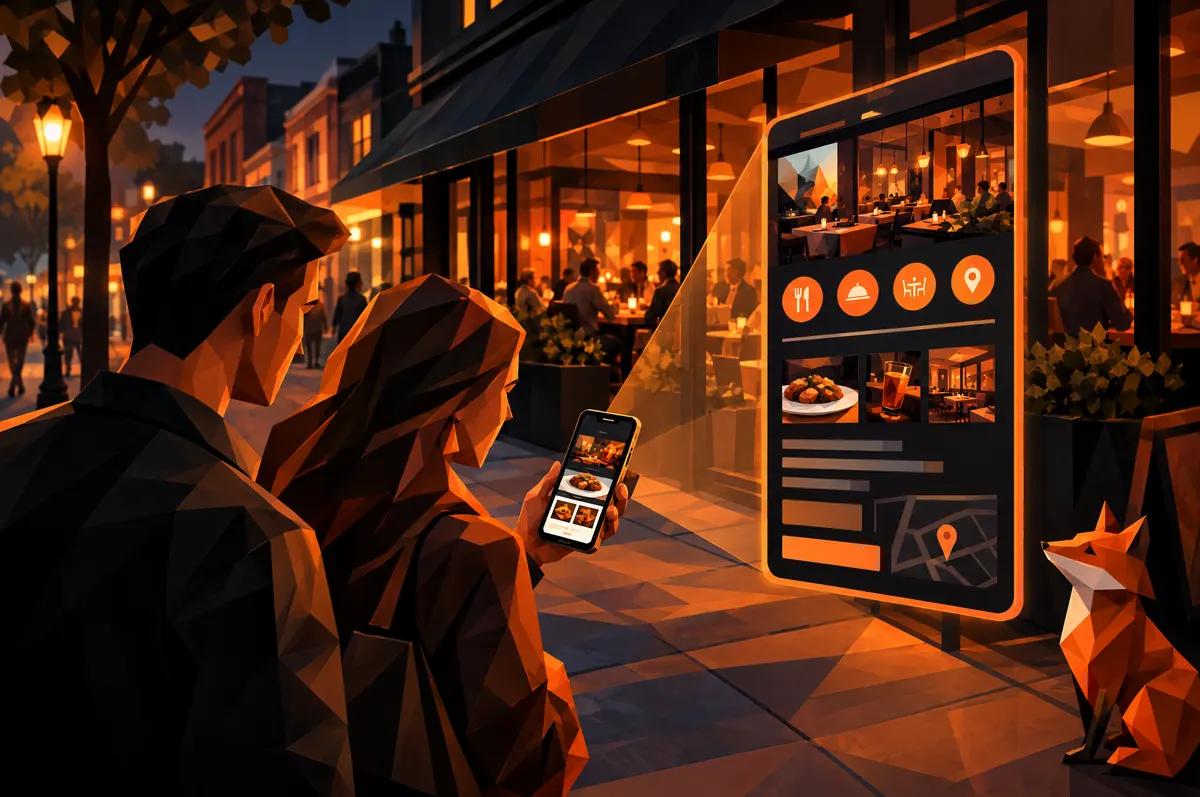
Picture a couple downtown on a Friday evening. They are hungry. They have a phone and no patience.
They type a search, tap a result, and decide in a few seconds whether your door is the one they walk through. A restaurant website for downtown walk-in traffic is a different job from a site built to impress.
What does a diner standing downtown need in the first five seconds?
Three things. The menu, the hours, and the address.
Not your story. Not a slideshow. Not a welcome message from the owner. Those can all be good, and none of them is why the person opened the page.
The test is simple. Open your homepage on a phone and ask whether a stranger could answer three questions without scrolling or squinting:
- Are you open right now?
- What do you serve?
- How do I get there?
If any answer takes more than a tap, you are making a hungry person work. They will not.
Why menu, hours and address belong one tap from every screen
Las Mas Mexican Kitchen & Bar has served downtown Wake Forest for 25 years. A reputation like that is earned over decades, and it can still lose a table in seconds if the website fails on a phone.
So when we built their site, the rule was blunt. Menu, hours and location sit within one tap of every screen. Not just the homepage. Every screen.
Visitors do not arrive where you expect. A search might land someone on a photo page, an event page or a story page. If the three essentials only live on the homepage, that visitor has to hunt.
A persistent, obvious way to reach the menu, hours and address is the cheapest conversion fix a restaurant has. It costs a design decision, not a budget.
What happens when the site is slower than the delivery app?
Be honest about the competition. It is not the restaurant across the street. It is the delivery app already installed on the diner's phone.
If your site makes someone wait, pinch and zoom, or download a PDF menu, the app is right there. The diner who was standing in front of your building becomes a customer of someone else's platform.
You can check your own speed in a minute with our speed test. Run it on your homepage and your menu page. The menu page is the one that usually surprises people.
How does food photography sell better than adjectives?
"Authentic." "Fresh." "Made with love." Every restaurant says these words, so they carry no information.
A photo of the actual plate does. It shows color, portion and care in the time it takes to glance at a screen.
For Las Mas, we designed appetite-forward layouts where the food does the selling. The photography leads, and the copy supports it.
A few habits that help:
- Use your real dishes, shot in decent light, not stock images.
- Make photos large on a phone. A thumbnail is not an appetite.
- Keep captions to a dish name and a line about what is in it.
- Compress images properly so beautiful photos do not make the page crawl.
That last point is the one people skip. A gorgeous page that loads slowly is worse than a plain one.
How do you carry 25 years of history without an unread about page?
Twenty-five years is an asset. A family story in a neighborhood is the one thing a delivery app cannot copy.
But the about page is where history goes to be ignored. Most visitors never click it, and the ones on the sidewalk certainly will not.
The better move is to weave the story through the site. For Las Mas, we carried the twenty-five-year family story across the pages instead of quarantining it in one place.
This works for two reasons. The story reaches people who never visit a dedicated page. And it stays out of the way of the three things they came for, because it arrives in small pieces.
History should flavor the site, not block the door.
Why is walk-in traffic a local search and mobile problem?
Walk-in traffic does not come from nowhere. Someone searches near where they are, sees a few options, and picks one.
That makes it a local search problem first. Your Google business details, your site's location signals and your page content all need to agree on who you are and where you are. A mismatch costs you trust and visibility.
It is also a mobile problem. Someone on a sidewalk is on a phone, probably on cell data. A site designed on a big monitor and merely shrunk down will feel wrong in that setting.
For Las Mas, we optimized for exactly the local search and mobile behavior that drives walk-ins to a downtown restaurant. Our local SEO and analytics service covers what that work involves.
What should you check from a phone on the sidewalk?
Do not audit your site at your desk. Walk outside, turn off Wi-Fi, and use it the way a diner would.
Then run through this list:
- Search your restaurant's name, then a plain phrase like "restaurant near me" in your town. Do you show up?
- Tap your result. Does the page appear quickly on cell data?
- Find the menu. Can you read it without zooming?
- Find the hours. Do they say whether you are open today?
- Find the address. Does tapping it open a map?
- Navigate to a photo page or an event page. Are the three essentials still one tap away?
Write down every moment of friction. That list is your to-do list, in priority order.
Which extras can wait until the basics work?
Plenty of things are nice. Not many are urgent.
Online ordering, a blog, a reservation widget, an events calendar and a newsletter signup can all earn a place. None of them should arrive before the basics are fast and obvious.
A good order of operations:
- First, menu, hours and address, one tap away, loading quickly.
- Second, strong photography and short copy.
- Third, the story, spread through the pages.
- Only then, the extras that fit how your restaurant actually runs.
Extras added too early tend to push the essentials down the page. Every new feature competes with the three things a walk-in diner wants.
How does a downtown restaurant keep diners off the delivery apps?
You will not beat the apps by shouting about them. You beat them by being the easier answer.
When someone searches for you, your site should load cleanly, answer the question and give them a reason to walk in. Real photos, a clear menu, current hours and a visible address do that. A history the apps cannot offer does the rest.
That is the approach behind the Las Mas site. Read the Las Mas Mexican Kitchen case study to see how it came together, or browse our page on restaurant website design for the wider picture.
Your next step
Tonight, stand outside, on cell data, and try to find your own menu, hours and address on your phone. Time it. If it takes more than a few taps or a few seconds, you know what to fix first.