
A working farm with a floral studio is not one business. It's at least two. Add a wedding venue and a workshop program, and you've got four different customers showing up at the same front door, each looking for something different.
Most farm and floral websites don't reflect that. They're built like brochures: a homepage, an about page, a services list, a contact form. That structure works fine for a business that sells one thing. It falls apart fast for a business that sells four.
If you run a farm, a floral studio, an event space, or all three at once, this is the mistake to avoid, and the fix that actually works.
Why One Homepage Can't Sell Four Different Things
Think about who actually lands on a farm and floral website. A bride searching for a micro-wedding venue in the Triangle. A local buyer looking for spray-free flowers for a weekly arrangement. A parent looking for a weekend workshop for their kid. A florist or shop owner looking to source wholesale.
Those are four different people with four different intentions, and none of them want to read the same page to find what they came for.
A generic template forces all four into one funnel: homepage, then a "services" page that lists everything in a paragraph or two, then one contact form for the whole business. The bride has to dig past workshop details to find venue information. The workshop parent has to scroll through wedding photos to find a class schedule. Everyone gets a worse experience than if the site had just been built for them specifically.
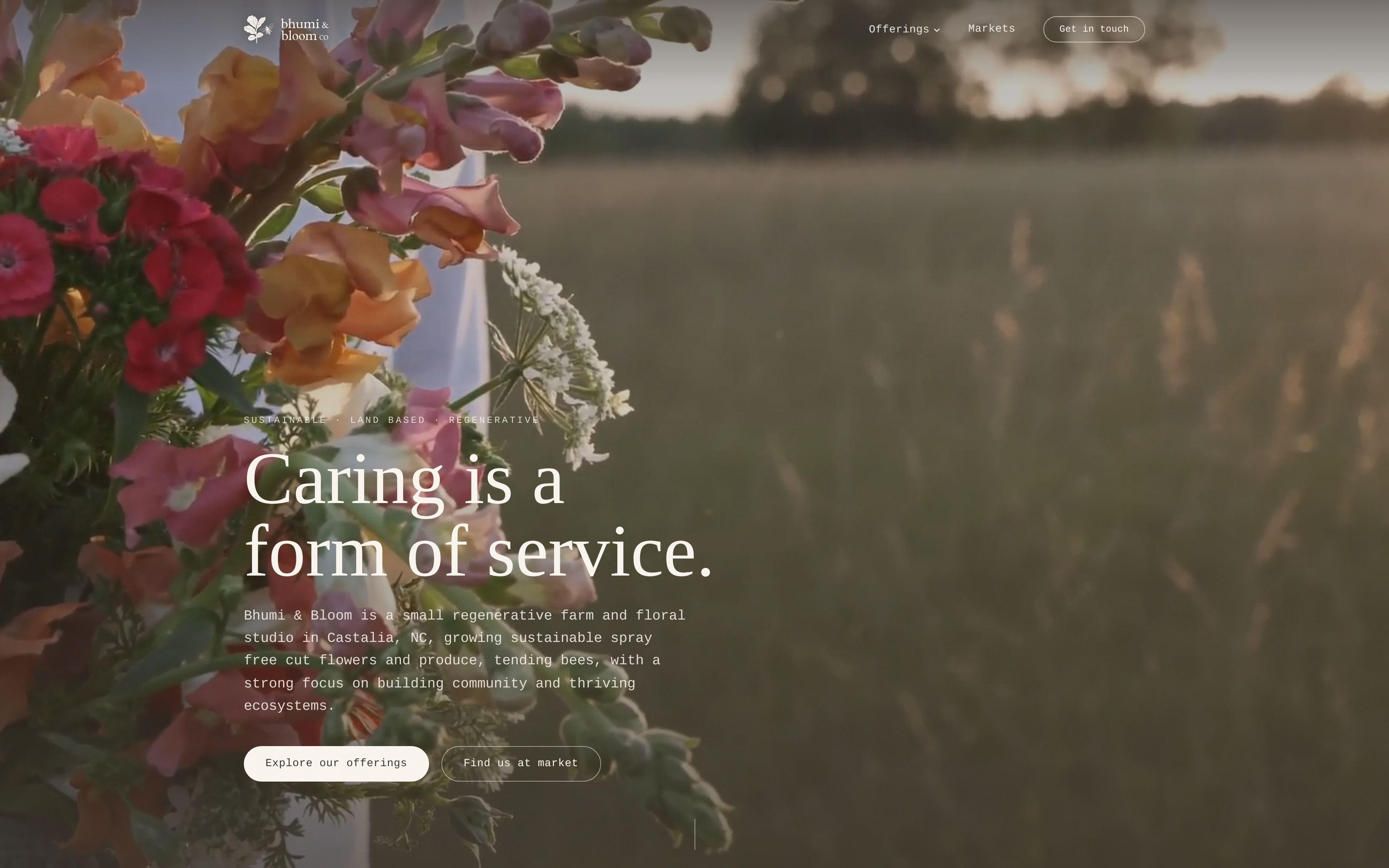
This is exactly the problem Bhumi & Bloom Co. had to solve. Bhumi & Bloom is four businesses under one name: a working regenerative farm, a floral studio, a micro-wedding venue, and a workshop program. Each one speaks to a different customer. A single generic template would have flattened all four into an unfocused list of services, and worse, it would have buried the thing that makes this farm worth choosing over a wire-service florist: the land itself.
Structuring the Site Around Revenue Lines, Not a Services List
The fix isn't a better homepage. It's a different structure entirely.
Instead of one page trying to represent everything, each revenue line gets its own space to sell on its own terms. The floral studio isn't a bullet point under "what we offer." It's a section with room to show arrangements, explain sourcing, and make its own case. The same goes for the wedding venue, the workshop program, and the farm itself.
This isn't just an organizational preference. It changes how the business performs online, in three specific ways:
- Each offer gets its own pitch. A wedding venue and a flower subscription are sold with completely different language, different pacing, and different proof points. Cramming them onto one page means neither gets built well.
- Visitors self-select faster. Someone who lands looking for workshops shouldn't have to read about weddings to find them. A clear structure gets people to the right offer in one or two clicks.
- The differentiator survives. For Bhumi & Bloom, the regenerative, spray-free growing practices are the reason to choose them over a wire-service florist. On a crowded, generic page, that story becomes a footnote. Structured correctly, it reads as the differentiator it actually is.
For a multi-revenue small business, this is the single biggest decision in the build. Get the structure right and everything downstream, the copy, the photography, the forms, has a place to do its job.
Letting Photography Carry the Story a Wire-Service Florist Can't Tell
Here's the thing a template can't fake: a sense of place.
Anyone can order flowers online. What they can't get from a wire-service florist is the feeling of a specific farm, grown a specific way, by specific people who care about the land. That feeling doesn't come from copy alone. It comes from photography.
For a farm and floral business, the site needs to be image-forward, not as decoration, but as the primary way the brand tells its story. Photos of the flowers themselves, obviously. But also the produce, the fields, the hands doing the work. That's what separates "a flower delivery" from "a flower delivery from this farm."
This is where a lot of small business sites underinvest. They treat photography as filler between paragraphs of copy. For a farm and floral business, it should be closer to the reverse: the images carry the story, and the copy hierarchy supports what the photos are already showing. When the practices behind the flowers, the produce, and the land are the reason customers choose you, the site has to make that visible, not just claim it in a paragraph.
Designing Separate Inquiry Paths for Weddings, Workshops, and Every Other Offer
A single "Contact Us" form is the clearest sign that a website wasn't built for a multi-revenue business.
A bride asking about a micro-wedding needs to share a date, a guest count, and a vision. A parent booking a workshop needs to see a schedule and pick a session. A regular flower customer just wants to place an order or ask a quick question. None of those inquiries should funnel into the same generic form, because none of those leads should be handled the same way on the back end.
Designing separate inquiry paths for each offer does two things. It makes the ask feel relevant to the person making it, which matters more than most business owners assume. And it hands the business better information from the start, since a wedding inquiry and a workshop signup arrive with the details each one actually needs, instead of a vague message that requires three follow-up emails just to figure out what someone wants.
For Bhumi & Bloom, this meant designing inquiry paths tuned to each individual offer, so a micro-wedding lead and a workshop booking follow entirely different routes from the moment someone clicks. That's not a nice-to-have for a business like this. It's the difference between a site that generates real inquiries and one that generates confusion.
What This Looked Like in Practice: Bhumi & Bloom Co.
Bhumi & Bloom Co. is a regenerative farm and floral studio, and it needed a website that could hold four distinct businesses without losing what makes it worth choosing in the first place.
The build was structured around exactly the approach above:
- The site was structured around the four revenue lines, the farm, the floral studio, the wedding venue, and the workshop program, so each one has room to sell on its own terms instead of competing for space on one crowded page.
- Layouts were built image-forward, letting photography of the flowers, produce, and land carry the brand's story rather than leaning on copy to do that work alone.
- The copy hierarchy was written and designed so the farm's regenerative, spray-free practices read as the differentiator they are, not a line buried at the bottom of a paragraph.
- Inquiry paths were designed around each specific offer, so a micro-wedding lead and a workshop booking follow different routes from click to submission.
That combination, revenue-line structure, image-forward design, and offer-specific inquiry paths, is what let a four-in-one business actually function online instead of getting flattened into one generic template.
If Your Business Sells More Than One Thing
If you're running a farm, a floral studio, a venue, a workshop program, or any combination of offers under one name, ask yourself honestly whether your current site is built for all of them, or whether it's built for one and the rest are just squeezed in.
If it's the latter, that's costing you inquiries you're not seeing, because visitors who can't quickly find their offer usually just leave instead of digging.
Start by running your current site through our free speed test to see where the technical foundation stands. Then, if you're ready to talk about restructuring the site around what your business actually sells, get started with a conversation. We'll walk you through what a build like this involves, using the same approach that shaped Bhumi & Bloom's web development and brand development.