
Picture a homeowner in a neighborhood with a strict HOA. They have three quotes and one nagging question. Has this crew ever painted anything near me?
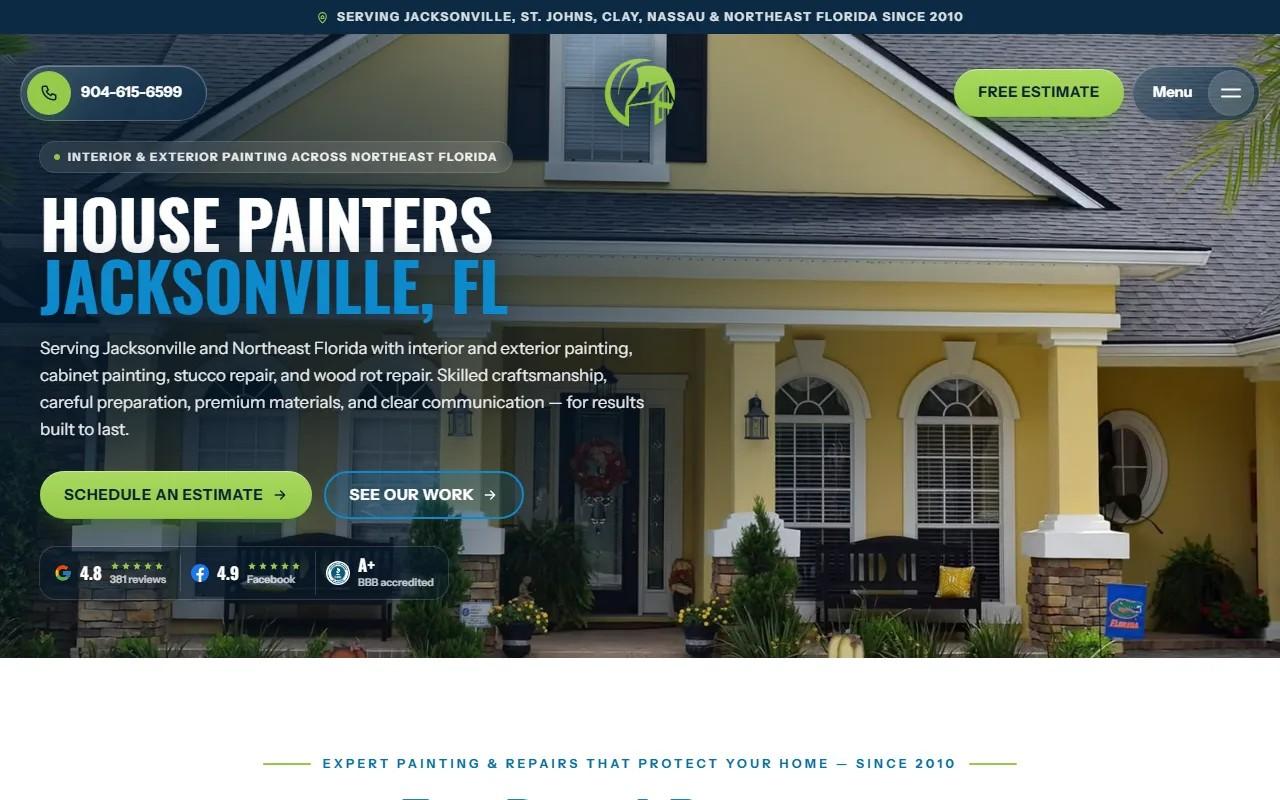
That question drove one part of the A New Leaf Painting rebuild. We gave every finished job its own page and plotted about five hundred past jobs on a map of Northeast Florida. Here is what we built and why. The full project is on the A New Leaf Painting case study.
Why do homeowners want to know you have painted near them?
Because a nearby job is the cheapest proof there is.
A painter who has worked in your town knows the stucco, the humidity, the HOA board and the paint that holds up on your side of the county. A painter who has not is learning on your house. Homeowners sense this, even if they never say it out loud.
A New Leaf has painted homes and businesses across Jacksonville and Northeast Florida since 2010. That is a long record. On the old site, though, a visitor had no quick way to see it. They had to take the company's word for it.
A map changes that. The visitor sees the pins, finds their own area, and the question answers itself before anyone picks up a phone.
What was wrong with the town pages before the rebuild?
The site had grown with the company. Hundreds of blog posts and paint guides, video stories from customers, and a page for nearly every town the crews work in. Then the site moved to a new platform and the move went badly.
Hundreds of old addresses were redirected to the homepage. Pages that search engines still listed were gone. The blog lost the markup that tells Google what a post is.
So the first job was repair. Every page came back at its original address with its own words carried over. Every address the site had ever published was traced and made to answer in a single hop, either to the page that replaced it or to a clean "gone" for thin, near-identical pages that should never have been published.
That last part matters for what comes next. A town page that says the same thing as its neighbor with the name swapped is not a service area page. It is filler. The rebuild set a higher bar.
What goes on a finished-job page besides photos?
Photos are the least of it. Anyone can post a photo.
Each job page on this site records:
- What the crew found. The condition of the house when they arrived.
- The prep and repairs. The unglamorous work that decides whether paint lasts.
- The products and colors. Exactly what went on the walls.
- The result in photos. The finished job.
- The HOA approval details. What neighbors ask about.
Read that list as a homeowner would. The first two items show a crew that looks before it paints. The third lets a buyer see real choices instead of a vague promise of quality. The photos then land with context, because the reader knows what they are looking at.
If your job pages are a gallery and a caption, you are leaving your best selling material off the page.
Why include HOA approval details on a job page?
Because the next homeowner in that community has the same problem.
Anyone painting in an HOA community needs approval before the first brush touches the wall. It is a common source of delay and worry. A page that shows how an approval went for a real job tells that homeowner the crew has been through the process and will not be surprised by it.
It also does quiet work for people who never call. A neighbor sees the job, wonders what is allowed, and finds the answer on a page instead of in an email thread with the board.
If you work in HOA country around Raleigh, Cary or Wake Forest, this is the detail to copy first. It costs a few lines per job and speaks directly to a real worry.
How do about five hundred past jobs become a useful map?
A pile of pins is not automatically useful. The point is the question it answers: has the crew painted near me?
Plotting about five hundred of Thomas Drake's past jobs on a map of Northeast Florida turns years of work into something a visitor can read in seconds. They do not need to scroll a portfolio or guess whether the crew covers their area. They look.
The map works because it is tied to the job pages. A pin is not decoration. It leads to a real finished job, with the findings, the prep, the products and the photos behind it.
That is the standard we would hold any contractor map to. If a pin goes nowhere, it is a prop.
Why does every town page get only its own jobs and its own map?
Because a town page should say something true about that town.
Each town page on the rebuilt site shows its own finished jobs and its own map. Nothing from another town sneaks in. A homeowner reading about painting in one town sees jobs done in that town.
This also fixes the thin-page problem from earlier. When every town page carries its own jobs, each one has real content that no other page has. Search engines can see the difference, and so can a person.
Pages that differ only by a swapped place name are the weakest thing a service business can publish. Local proof is how you make each page earn its address.
Why never caption a neighbor's job as local?
Because homeowners know their own streets.
It is tempting. A town has no finished jobs yet, a neighboring town has plenty, and a caption that blurs the two fills the gap. We did not allow it. No other town's name appears on a page, and no neighbor's job is passed off as local.
The reasoning is simple. If a reader spots one job that is not actually in their town, every other claim on the page gets discounted. Trust is the whole product here. A painter is asking to be let into someone's home.
The honest version of a thin town page is a shorter page. We would take short and true over long and padded every time. If a town has few jobs, the map shows few jobs, and the next finished job fixes it.
How do the job pages feed the reviews and search markup?
They sit on top of the same foundation as everything else.
A New Leaf's reviews from Google, Facebook, Houzz and Yelp now live on one page beside the customer films. Each review is marked with where it was first posted. The review figure comes from one place, so every page and its search markup agree.
The same thinking runs through the whole build. Every business fact, from the founding year on the state record to the insurance limit, comes from one source. With hundreds of pages, facts drift unless something stops them. A single source stops them.
On top of that sits clean search markup: one business described once, breadcrumbs on every page and article markup on every post. Job pages, town pages, reviews and markup all tell the same story. That consistency is what local SEO work is made of.
What can a Triangle contractor copy from this build?
You do not need five hundred jobs to start. You need a habit.
- Give each finished job its own page. Record what you found, the prep and repairs, the products and colors, and the result.
- Add approval details where they apply. HOA, permits, historic district rules. Whatever neighbors ask about.
- Put jobs on a map once you have enough to make it meaningful.
- Keep each town page honest. Only that town's jobs, only that town's map.
- Pull business facts from one source so your pages never contradict each other.
Contractors in Raleigh, Durham and Chapel Hill are in the same position as a Jacksonville painter. Your next customer wants to know whether you have worked near them.
Start with one thing this week. Pick your last three finished jobs and write down what you found, what you prepped and repaired, and which products and colors you used. That is three job pages waiting to be built. When you want help building them into a site, see our contractor website design work or get started.