An agency's website is the hardest brief it will ever take. Every other client gets the benefit of the doubt. The agency's own site is the proof.
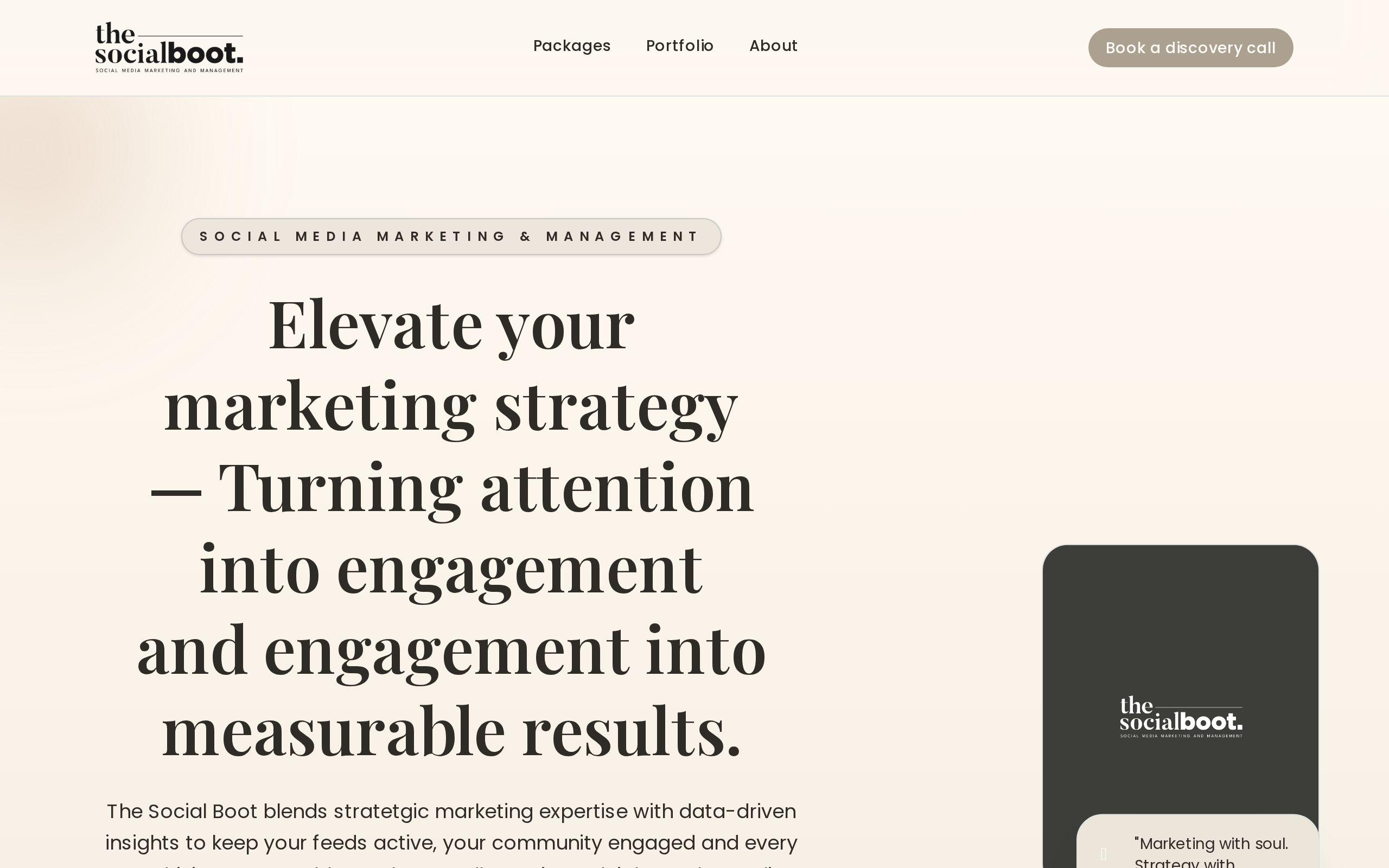
When The Social Boot came to us, that was the tension at the center of everything. This is a digital marketing agency. It sells positioning, brand, and getting found online. If its own site looked generic, sounded vague, or made a prospect dig for basic information, none of the rest would matter. The site had to do what the agency tells its clients to do.
So instead of building another polished-but-safe agency site, we built one that makes a decision on the homepage: this agency is for small and mid-size business owners who know what they want and don't want to be sold to. Everyone else can look elsewhere. Here's how that decision shaped the brand, the pricing, and the booking flow.
The Hardest Brief an Agency Ever Takes: Its Own Website
Most agency websites read the same. Dark hero image, stock phrase about "driving results," a contact form that promises a callback. It's not that these sites are bad. It's that they're interchangeable. A visitor can't tell one agency from the next, so they default to whichever one seems cheapest or whoever responds first.
The Social Boot didn't want to compete on that field. The brief we took on was to build a site that could stand in for a sales conversation, one that qualifies a prospect and moves them toward booking before a human ever gets on the phone. That meant three things had to work together: a brand identity strong enough to be remembered, pricing transparent enough to filter the wrong-fit leads out, and booking simple enough that the right-fit leads didn't have to wait.
We treated it as brand strategy and brand development work first, web design and custom web development second. Get the identity and the positioning right, and the site becomes the easy part. See the full project at The Social Boot case study.
Why Publishing Pricing Tiers Was the Right Call, Not a Risk
Most agencies hide pricing behind a form. The logic is defensive: keep the number vague, get the prospect on a call, let a salesperson handle the objection. It feels safer. It also means every lead who fills out that form still needs to be qualified by a human, one at a time, including the ones who were never going to be a fit.
The Social Boot published clear pricing tiers instead. That single decision does the qualifying work automatically. A small business owner who can see the number knows in ten seconds whether this is in range. If it isn't, they leave without costing anyone a phone call. If it is, they arrive at the next step already sold on the investment, ready to talk about scope instead of sticker shock.
This only works if the rest of the site backs it up. Vague pricing next to vague design reads as uncertainty. Specific pricing next to a confident, well-built site reads as an agency that knows exactly who it serves and isn't afraid to say so.
Building a Brand Bold Enough to Stand Out From Interchangeable Agencies
Transparency earns attention. Brand is what makes people remember what they saw. Digital marketing is a crowded category, and most agencies in it look like variations on the same template: similar color palettes, similar stock photography, similar language about growth and strategy.
We built The Social Boot's identity to be the opposite of that. The brand strategy and brand development work gave the agency a distinct visual language, one built to survive next to a dozen open tabs of competitors and still be the one a visitor remembers an hour later. That identity carries through every page, not just the homepage hero, so the confidence of the brand and the confidence of the pricing page reinforce each other instead of contradicting each other.
For an agency, this is also the clearest possible demonstration of capability. If The Social Boot can commit to a bold identity for itself, a prospective client can trust it to do the same for them. Explore how we approach this kind of work on the brand development page.
Integrating Booking to Remove the Back-and-Forth Between Interest and a Call
A visitor who clears the pricing filter and likes the brand still has to become a booked call. That's where most agency sites lose momentum. A contact form goes into an inbox, someone replies a day later with three time options, the prospect picks one, someone confirms. Every step is a chance for interest to cool off.
We built booking directly into The Social Boot's site, so a qualified visitor can go from "this looks right" to "I have a call on the calendar" without leaving the page or waiting on a reply. That's custom web development doing real work, not just decoration. The integration exists specifically to protect the momentum that the pricing and brand work built.
For a self-serve buyer, in particular, speed matters. Someone who was comfortable making a decision based on published pricing is also comfortable booking a time without a sales email in between. Making them wait for a reply undoes the trust the rest of the site just built. Details on how we build this kind of functionality are on the custom web development page.
Designing for Small and Mid-Size Buyers Instead of Enterprise Language
The last decision tied everything together: who the site is actually talking to. A lot of agency sites default to enterprise language, big claims about scale and transformation, because it sounds impressive. But The Social Boot's actual buyer is a small or mid-size business owner who needs clear help, not a boardroom pitch.
So the copy, the pricing structure, and the booking flow were all built around that person specifically. Not "book a discovery call to explore a partnership." Just: here's what it costs, here's what you get, here's a time on the calendar. That specificity is a form of respect. It tells the right buyer, quickly, that this agency understands their world.
What This Means If You're Evaluating Your Own Site
If your website reads like every competitor's, and every lead that comes through still has to be manually sorted into "worth a call" and "not a fit," the site isn't doing its job. It's generating contacts, not qualified prospects.
The fix usually isn't more traffic. It's a site built to filter and move the right visitors forward on its own, the way The Social Boot's does.
Start by checking how your own site currently performs with our free speed test, then talk to us about what a self-qualifying site would look like for your business at Get Started.