
A hungry person standing on Fayetteville Street does not open your homepage. They type "tacos near me" or your name, and Google hands them a card. That card is your Google Business Profile.
If you run a restaurant in Raleigh or anywhere in the Triangle, this post is about that card.
Why does your Google Business Profile matter more than your homepage to a hungry diner?
Because it shows up first, and it answers the question fast.
The profile gives a diner your hours, your phone number, a map pin, a few photos, a menu link and some reviews. All of it sits on one screen. For plenty of walk-in decisions, that is the entire visit. They never reach your site.
That changes how you should think about the work. Your website is the deep end. Your profile is the front window.
Nobody walks past a restaurant with a dark window and a crooked sign, then comes back later to read the about page.
Which Google Business Profile fields do restaurants most often get wrong?
The same few, over and over:
- Hours that were right two summers ago
- No holiday hours at all
- A menu link that points to a PDF, a dead page, or a delivery app
- Photos that are old, dark, or uploaded by strangers
- A primary category that is too broad
- Attributes left blank
Notice that none of these are clever. They are housekeeping. That is good news, because housekeeping is free and it is fixable this afternoon.
The rest of this post goes through them in order of how much damage they do.
How should you choose a primary category and secondary categories for a restaurant?
Pick the category that describes what you are, not what you hope to be.
"Mexican restaurant" beats "Restaurant." "Barbecue restaurant" beats "Restaurant." The primary category tells Google what kind of searcher should see you, and a vague one invites a vague match.
Then add secondary categories, but only for things that are true. A bar inside your restaurant? Add it. A catering arm you actually run? Add it. A category you added because it sounded popular will bring in people you cannot serve and a few unhappy reviews.
Our rule: one precise primary, two or three honest secondaries. Stop there.
Why should hours and holiday hours be right before anything else?
Because a wrong hour is the only mistake that sends a diner to a locked door.
Someone drives across town, trusts your profile, and finds the lights off. They do not blame Google. They blame you, and they say so in a review.
Check three things:
- Regular hours for every day, including the slow ones
- Holiday hours, set ahead of Thanksgiving, Christmas, New Year's and anything local that changes your week
- Special hours for private events or early closes
Triangle restaurants live around game days, graduation weekends and festivals. If those change your schedule, the profile should say so before the day, not after the complaint.
How do you link your menu so diners do not leave for a delivery app?
Send them to your own menu first.
If the profile menu link lands on a delivery app, you have handed the diner to a third party at the moment they were ready to choose you. They see fees, other restaurants and a dozen competing offers.
Link to a menu page on your own site instead. It should:
- Load fast on a phone
- Be real text, not a scanned image
- Show current dishes and prices
- Offer your order and call options clearly
Delivery apps are fine as a channel. They should not be the front door.
What photos should a restaurant profile show?
Food, room, and front door. In that order of importance.
Diners decide with their eyes. Show the dishes people actually order, shot in daylight, plated the way they arrive. Add a few of the dining room so people know what to expect. Add one clear shot of the entrance so a first-timer can find you from the street.
Skip stock images and skip anything heavily filtered. A diner who sees one thing online and gets another at the table feels misled.
Add new photos on a regular schedule. A profile with photos from years ago looks like a restaurant that has stopped paying attention, even when the kitchen is better than ever.
How should your website back up what the profile says?
By agreeing with it, exactly.
Hours on the profile and hours on the site must match. So must the address, the phone number and the menu. When they disagree, the diner trusts neither, and Google has a harder time knowing which to believe.
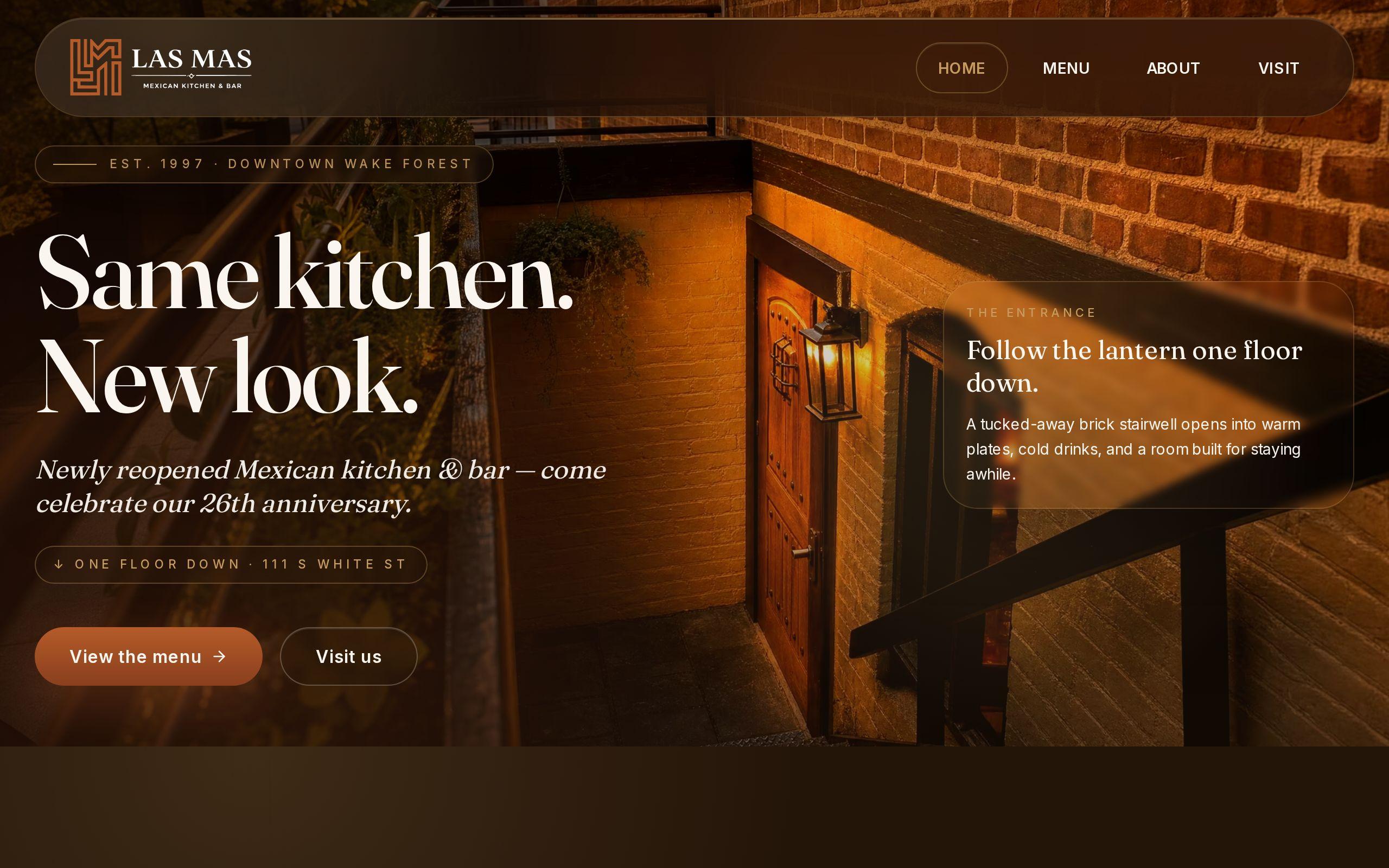
Our work on Las Mas Mexican Kitchen & Bar in Wake Forest started from this idea. After twenty-five years downtown, the restaurant has a reputation. What it needed was a site that worked for someone deciding on a phone from the sidewalk. So the menu, hours and location sit within one tap of every screen. Those are what a hungry visitor came for. Anything slower and they open a delivery app instead.
The profile and the site should tell the same short story. If you are rethinking the site side, our page on restaurant website design covers it.
How do you keep the profile current without it becoming a chore?
Give it an owner and a calendar.
One person is responsible for the profile. Not "the team." One name. That person runs a short check on the first of each month:
- Are the hours right for the coming weeks?
- Does the menu link still work?
- Is there a fresh photo from the last month?
- Have recent reviews been answered?
Ten minutes. Add a second pass before every holiday.
When the menu changes, update the site first, then the profile. When the hours change, do both on the same day. That habit alone prevents most disagreements between the two.
If you want help with the wider picture, our SEO and analytics work covers local search for Triangle businesses.
Your next step this week
Pull up your own profile on your phone, standing outside if you can. Then check four things: hours, menu link, primary category, and the first three photos.
Fix what is wrong. Then open your website and make sure it says the same thing.
That takes less than an hour, and it is the first page your next diner will see.