
It is 6:40 on a Friday. Someone is standing on a sidewalk in Raleigh, Durham or Cary, hungry, with a phone in one hand. They type a search. They will give the first few results a few seconds each.
That is the whole game for local SEO for restaurants in the Triangle, NC. Everything else is a footnote.
Why do diners pick the restaurant they can read fastest on a phone?
Because they are not researching. They are deciding.
A person comparing accountants will read three pages. A person deciding on dinner wants to know four things: what you serve, whether you are open, where you are, and whether it looks good. If your site makes them pinch, zoom and wait, they move on.
Worse, they do not move on to a competitor. They move on to a delivery app, which loads fast and shows food.
Reputation does not fix this. A restaurant can be loved for decades and still lose the sidewalk decision to a page that will not load.
What did Las Mas teach us about the street decision?
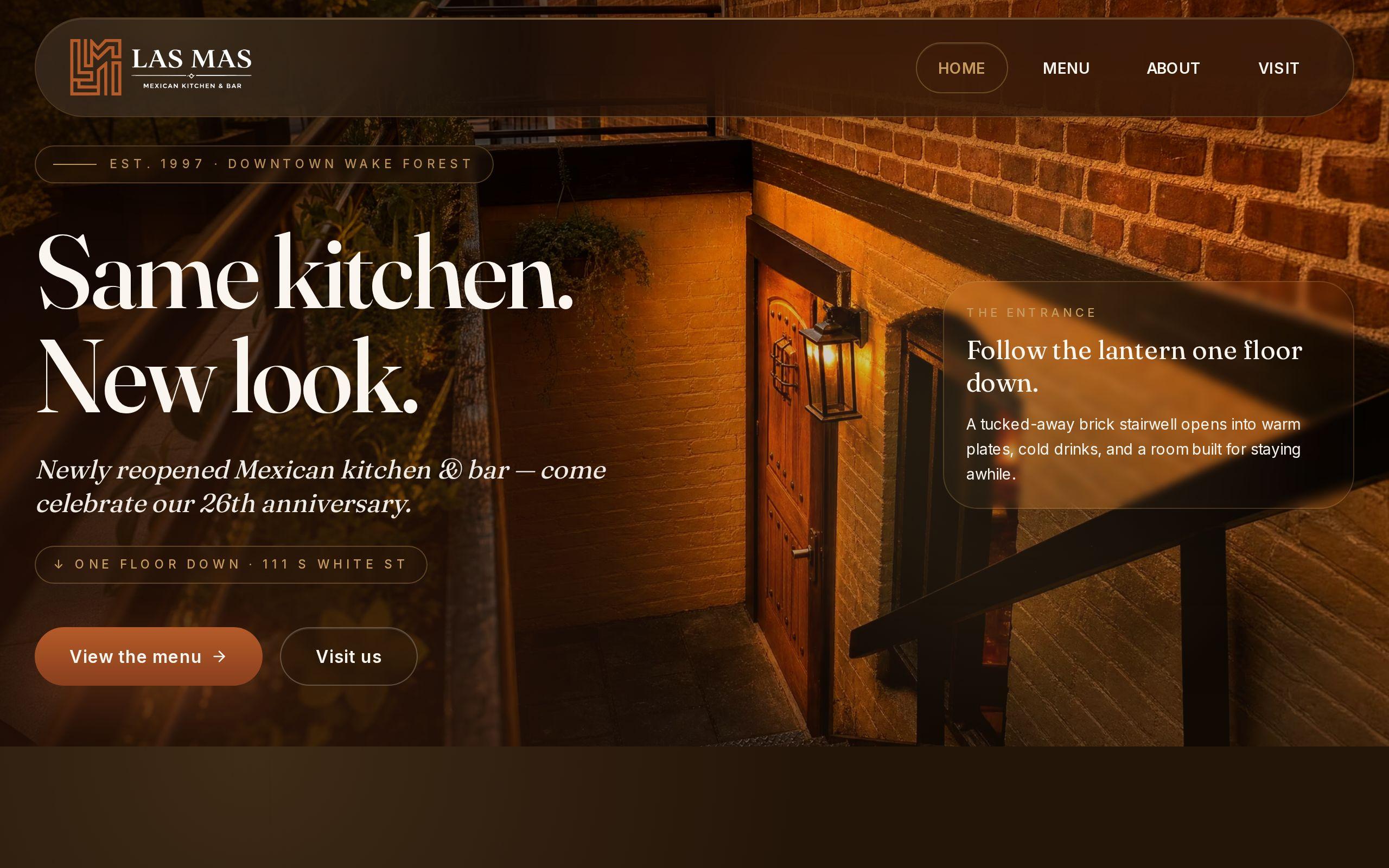
Las Mas Mexican Kitchen & Bar has served downtown Wake Forest for twenty-five years. That earns a lot of goodwill. It does not earn a usable phone experience.
The job was simple to state. Get the menu, the hours and the address in front of a hungry visitor in seconds, and make the site do that while still carrying a quarter century of family history.
You can read the full story in the Las Mas case study. The short version: we built around what the visitor came for, not around what the owner wanted to say first.
What does a restaurant's Google Business Profile need beyond hours and address?
Hours and address are the entry fee. Plenty of restaurants stop there and wonder why the profile does nothing.
Fill in everything Google gives you:
- The correct primary category, plus any secondary ones that are true
- Accurate holiday and special hours, updated before the holiday, not after
- Your menu link, pointing to the menu page on your own site
- Real photos of the food, the room and the entrance
- A phone number that a human answers
- Replies to reviews, good and bad, in a normal voice
Photos matter more than owners expect. A diner scanning the map pack is looking at pictures before they read a word. Dark, blurry shots of a plate cost you the click.
Treat the profile as your real front door. For most walk-in restaurants, more people see it than ever see the website.
Should your menu live on your website as text instead of a PDF?
Yes. Without exception.
A PDF menu on a phone is a tiny document you have to drag around. It loads slowly, it is awkward to read, and search engines get far less out of it than they do from a plain page.
Put the menu on a page as text, with headings for appetizers, entrees, drinks and so on. Add the food photos around it. Update it when prices or dishes change, and do it in one place.
Text menus also let you write dish names the way a local would search them. Someone looking for a particular dish near them can actually land on your page.
If your current menu is a PDF, this is the single highest-value fix on this list.
How do you make menu, hours and location one tap away on every page?
Do not make people hunt. On Las Mas, we put the menu, hours and location within one tap of every screen, because those are what a hungry visitor actually came for.
On a phone, that usually means a persistent bar or button set that stays visible as the page scrolls. It also means:
- A tap-to-call phone number
- An address that opens directly in the map app
- Today's hours shown up front, not buried in a footer
- A menu button that never disappears
Test it yourself. Open your site on your phone, stand up, and try to find the closing time with one thumb. If it takes more than a moment, a stranger will not bother.
Speed matters here too. You can check how your site loads with our free speed test before you decide what to fix first.
Which local keywords actually bring in walk-in diners?
Not broad ones. A restaurant does not need to rank for "best food" or compete with national food sites.
You need to be found by someone near you who is ready to eat. That means searches built from three things:
- What you serve, such as tacos, barbecue or brunch
- Where you are, such as your town or neighborhood
- The moment, such as open now, lunch or happy hour
Those phrases belong on your pages in plain, natural language, in headings, in the menu and in a short description of your location. Do not stuff them. A page that reads like a human wrote it for a hungry human performs better than one that repeats a town name nine times.
For a Wake Forest restaurant, the local page matters. Our Wake Forest page shows how we think about the area.
Do you need a blog to win at local search?
Probably not. This is where we part ways with a lot of SEO advice.
A walk-in restaurant is not competing on articles. It is competing on a complete profile, a fast site, a readable menu and consistent details. Publishing weekly posts while your hours are wrong on Google is rearranging furniture in a house with no roof.
If you have time left after the basics, share real news: a new seasonal menu, a patio opening, a private event space. But finish the basics first.
Why do consistent local signals matter?
Google checks its facts. If your name, address and phone number read one way on your website, another way on your profile, and a third way on a directory listing from years ago, you look less certain.
Pick one version of each and use it everywhere. Same spelling of the name. Same suite or no suite. Same phone number.
Then audit the places that copy your details: directories, review sites, social profiles, the chamber of commerce listing, and any delivery platform. Fix the old ones. Remove duplicates.
This is dull work. It is also the kind of work that quietly lifts a restaurant in the map pack while competitors chase tricks.
How does a long family story help local search instead of hurting it?
Las Mas has twenty-five years of family history. The usual move is to put it on an About page, where almost nobody goes.
We did the opposite. We wove the story through the site, so a diner meets it while they look at the food and the hours. A line about the family beside the menu does more than three paragraphs on a page nobody opens.
Here is why it helps search. Longevity, a real place and real people are exactly what make a business feel local and trustworthy. They also give your pages honest, specific words that are about your restaurant and no one else's.
The rule: the story supports the decision. It never stands between a diner and the menu.
Where do delivery apps fit, and how do you keep your own site ahead of them?
Delivery apps are useful. Some customers want delivery, and being there can bring orders you would not otherwise get.
But they are also where a diner lands when your site fails them. A slow page, a PDF menu and a hidden phone number are an invitation to open the app instead. Then you are paying a commission on a customer who was already looking for you.
Keep your own site ahead by being faster and clearer than the app on the things that count: your real menu, your real photos, your real hours, one tap to call or get directions.
Give people a reason to come straight to you. If you offer ordering, make it simple and put it where the menu is.
What can a Triangle restaurant owner fix this week?
Do these in order. None needs a big budget.
- Open your Google Business Profile and check hours, categories, menu link and photos.
- Replace any PDF menu with a text menu page on your site.
- Put menu, hours and location within one tap on your phone view.
- Run your site through the speed test and note what is slow.
- Compare your name, address and phone number across every listing, and fix the mismatches.
If you want a second set of eyes, our SEO and analytics work starts with exactly this kind of review. Start with step one today. It takes about as long as a coffee.