
Picture a couple on Main Street in Wake Forest. It is 6:15 on a Friday. They are hungry, a little indecisive, and holding a phone.
They will not read your About page. They will not zoom into a PDF. They will pick the first place that answers three questions fast: Is it open? Where is it? What is on the menu?
That is restaurant local SEO in Wake Forest, NC, in one scene. Everything below is about answering those three questions before the couple gives up and opens a delivery app.
What are hungry diners in Wake Forest actually typing?
Short, impatient things. "Mexican food near me." "Restaurants open now." "Brunch Wake Forest." Sometimes a restaurant's name plus the word "menu" or "hours."
Notice what is missing. Nobody types a paragraph. Nobody researches. They scan a map, glance at a few names, and tap.
That means you are competing on a small screen, in a few seconds, against the restaurant two blocks over. The map pack, those three listings Google shows above everything else, is where most of that decision happens.
Your job is to show up there, and then make sure the next tap lands somewhere that confirms what the listing promised.
Why does your Google Business Profile do most of the work?
Because for a walk-in restaurant, it is the storefront. It shows your name, rating, hours, photos, and a button to call or get directions. Many diners never reach your website at all.
So treat it like the main event:
- Pick the most accurate primary category, then add secondary ones that truly fit.
- Write a plain description of what you serve and where you are.
- Link the menu and ordering buttons to real pages on your own site.
- Keep special hours current for holidays and closures.
- Answer reviews like a person, good and bad.
None of this is glamorous. It is maintenance. The restaurants that win the map pack are often just the ones who kept the profile fresh while everyone else forgot the login.
Is your menu a page Google can read or a PDF it cannot?
If your menu is a scanned PDF or a photo of a printed page, you are asking a hungry person on a phone to pinch, zoom, and squint. Many will not bother.
Search engines have the same trouble. Text locked inside an image is much harder to read than text on a page.
Build the menu as an actual web page:
- Dishes and descriptions as real text.
- Clear sections: appetizers, entrees, drinks.
- A layout that works with one thumb.
- A link to it straight from your Google profile.
Now when someone searches for a specific dish, your page has words that match. And when they land, they see the menu immediately, not a download prompt.
Do your hours and address say the same thing everywhere?
They must. This is the dullest advice in local SEO and also among the most useful.
Google builds confidence in a business by comparing what different sources say about it. Your website says you close at 9. Your profile says 10. A directory still lists last year's phone number. That mismatch makes you look unreliable to a search engine, and it sends real people to a locked door.
Pick one version of your name, address, phone number, and hours. Write it down. Then check it in each place:
- Your Google Business Profile.
- Your website header and footer.
- Facebook, Yelp, and any other listing sites.
- Delivery and reservation apps.
When hours change, change them everywhere the same day. Put it on a checklist. It saves more disappointed diners than any ad.
Should a 25-year-old restaurant tell its history on the site?
Yes, but carefully. Twenty-five years downtown is a real asset. It says this place has earned its seat.
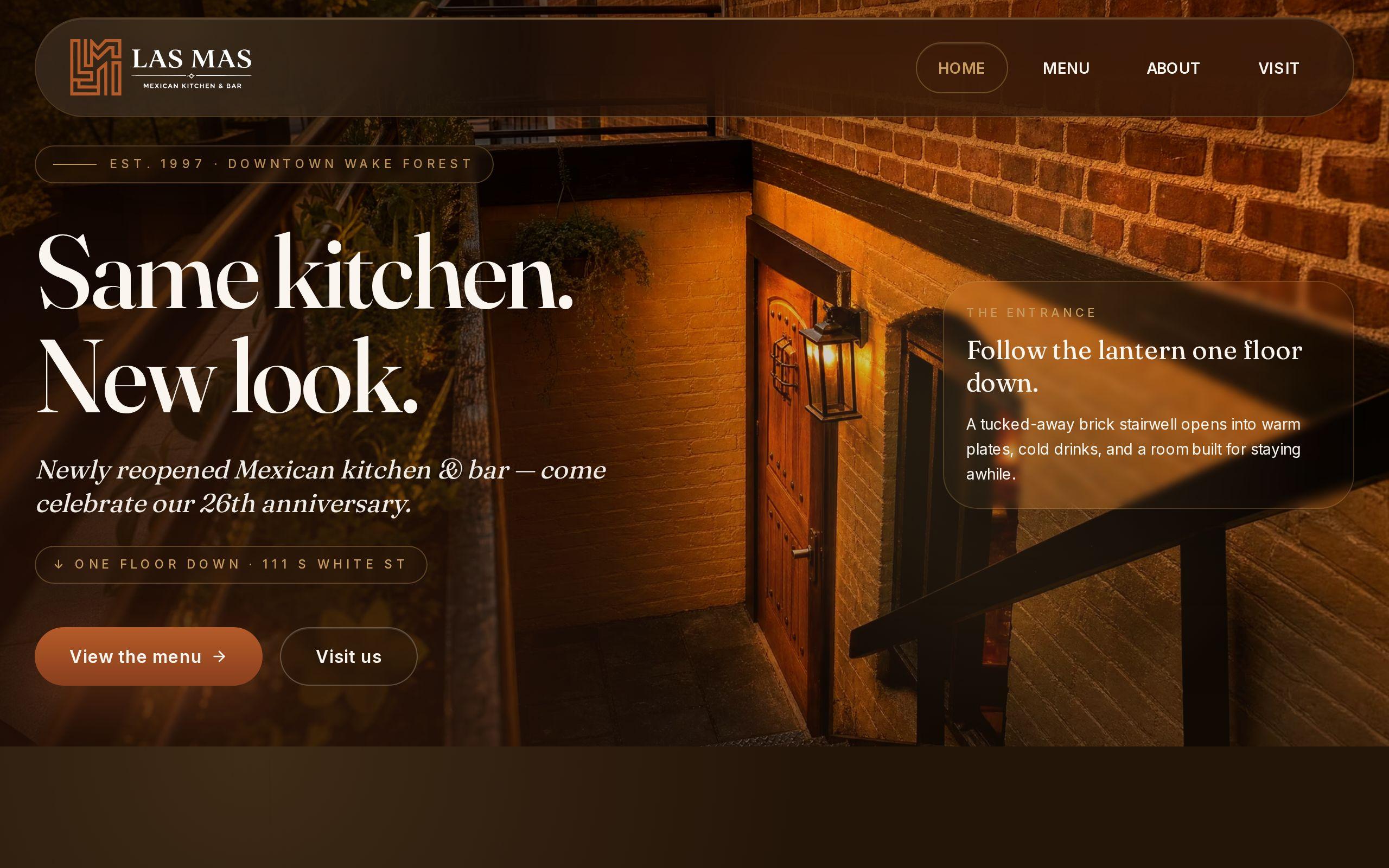
The mistake is parking all of that on an About page that nobody visits. When we built the site for Las Mas Mexican Kitchen & Bar, a Wake Forest restaurant with a 25-year family story, the goal was to weave that history through the whole site instead of quarantining it.
The story shows up in small doses, next to the food and the info people came for. A line here, a photo there. It builds trust without making a hungry visitor wade through it.
If your restaurant has history, use it as seasoning, not as the main course.
Which photos earn their place?
The ones that make someone hungry. Plates, drinks, the dining room with people in it. Skip the stock images and the dark phone shots of a menu board.
Food photography should do the selling, so you do not need adjectives like "authentic" or "delicious" doing the work.
For your profile, upload real photos regularly. Include the exterior so a newcomer recognizes the door when they walk up. Add a few of the interior so they know what to expect.
For your website, use the same visual style. If the profile looks warm and busy and the site looks like a template, the story splits in two.
How do you check your mobile experience like a diner on the sidewalk?
Do it for real. Step outside, turn off Wi-Fi, and use cellular data. Then try this:
- Search for your restaurant by name. Do you see the right hours?
- Search "restaurants near me" from your block. Do you appear?
- Tap through to your site. How long until you can see the menu?
- Find the address and phone number. Can you tap to call or get directions?
- Try to do all of it with one hand.
The standard we hold ourselves to on restaurant sites is simple: menu, hours, and location within one tap of every screen. That is what a hungry visitor came for.
You can also run your site through our speed test to see how it loads. Slow pages lose people before they read a word.
What should you fix first this week?
Start with the cheap, high-impact work, in this order:
- Audit your hours. Compare your profile, site, and top directories. Fix every mismatch.
- Replace the PDF menu with a real web page, and link it from your profile.
- Refresh your photos on the profile with recent, appetizing shots.
- Test on a phone, outside, on cellular data. Write down every moment of friction.
- Reply to your recent reviews.
If your site needs more than a patch, our restaurant website design work and our SEO and analytics services are built around exactly this problem.
Your next step today is small. Take out your phone, stand outside your own front door, and search for your restaurant. Whatever annoys you first is what to fix first.