
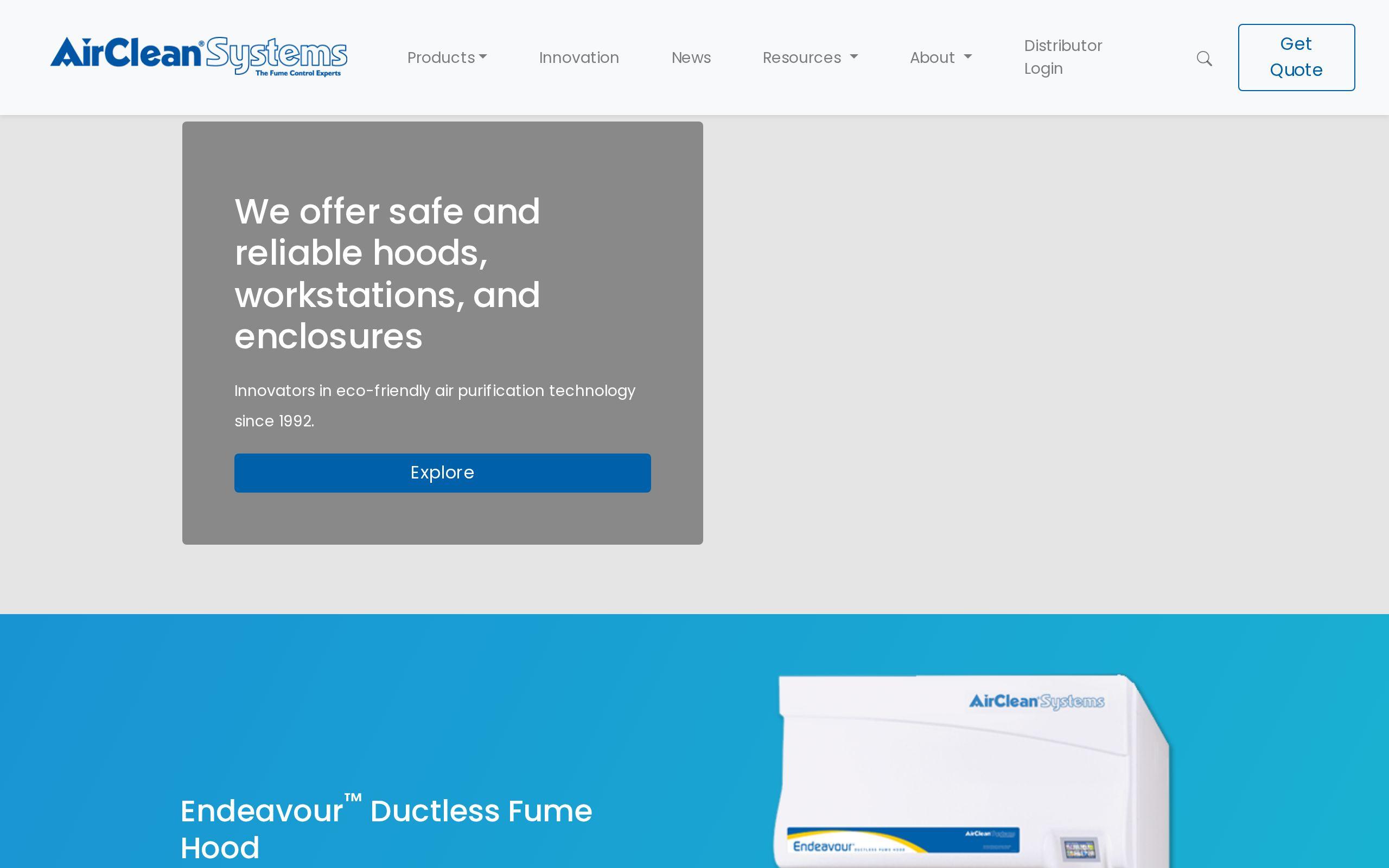
What Happens When One Website Has to Sell to Two Different Buyers?
Air Clean Systems has a problem a lot of good businesses have and almost nobody plans for: two customers who don't shop alike walking through the same front door.
A homeowner lands on the site because their air quality is bad and they want to know, fast, what fixes it. A commercial buyer lands on the site running a procurement process, comparing specifications, and building a case for a purchase order. Same company. Same product line. Completely different reason for being there.
Most sites handle this by picking a middle ground. A little bit of homeowner language, a little bit of commercial detail, one contact form for everyone. It's an understandable instinct. It's also the wrong call, and it's the first thing we had to talk Air Clean Systems out of.
Why Was a Single Generic Page the Wrong Answer for Air Clean Systems?
A compromise page asks both buyers to do extra work. The homeowner has to wade through spec sheets and model comparisons to find the simple answer they came for. The commercial buyer has to hunt past homeowner-friendly copy to find the technical detail their procurement process actually requires.
Neither buyer is patient. The homeowner leaves and calls a competitor. The commercial buyer, who's often building a comparison document for someone else's approval, moves the site to the bottom of the list because it didn't give them anything to work with.
The instinct to build one page that works for everyone is really an instinct to avoid a harder decision: picking a structure for each buyer and building each properly. Air Clean Systems needed both, on the same site, without one degrading the other. That meant the fix wasn't a better single page. It was two paths.
How Did Splitting Residential and Commercial Paths Change the Layout?
We built the site so residential and commercial buyers each get a route that matches how they buy. That sounds simple. It changes almost everything underneath it.
A homeowner's path is short and answer-first. It assumes they don't know model numbers or technical terms, and it gets them to a decision quickly.
A commercial buyer's path assumes the opposite: they know roughly what they need, they're comparing it against a spec, and they want to move through detail efficiently, not be walked through basics.
Splitting the paths meant rethinking:
- Navigation, so each buyer finds their route immediately instead of guessing which section applies to them
- Page structure, since a quick-answer flow and a comparison-driven flow don't share a template
- The language on the page, matched to how each buyer actually talks about the problem
None of this works if the split feels like two separate websites stapled together. The brand and the product line still had to hold together underneath.
What Does a Specification-Driven Buyer Need That a Homeowner Doesn't?
A commercial buyer isn't making an emotional decision about comfort in their living room. They're building a case. Usually for someone else's sign-off.
That buyer needs the product categories organized so they can navigate straight to the right system, without translating homeowner language into commercial requirements first. We organized product categories specifically so a specification-driven buyer can move directly to what applies to their project, rather than filtering it out of content written for someone else.
That's a navigation and information-architecture problem as much as a design one. If the commercial buyer has to dig, they'll assume the company doesn't do commercial work seriously, and they'll go find a site that clearly does.
Why Lead With Capability Instead of Company History?
Most service sites open with a story: who we are, how long we've been around, why we care. It has its place. It is not what either Air Clean Systems buyer needs first.
We built a service-forward layout that leads with capability rather than company history. Both buyers arrive already knowing they have a problem. What they want to know immediately is whether this company can solve it.
Capability-first design means the page opens with what the systems do and what they handle, before it opens with the company's backstory. It's a small ordering decision that changes how fast a visitor decides this is the right site to be on. For a business selling into a commercial procurement process, that ordering decision matters even more, since spec sheets don't lead with "About Us" either.
How Was Lead Capture Tuned Differently for Each Audience?
A homeowner filling out a form and a procurement contact filling out a form are not answering the same questions in their head, so we tuned lead capture separately for each audience.
The residential inquiry needs to be short. Property type, the problem they're having, how to reach them. Anything longer than that and the homeowner abandons it.
The commercial inquiry needs more, because the two inquiries need different information. A commercial contact expects to provide project scope, specification detail, or the kind of information that lets a sales team respond with something useful instead of a generic follow-up call.
Getting this backwards breaks both. A long form scares off the homeowner. A short form sends the commercial team a lead with none of the detail they need to move the deal forward. Matching the form to the buyer isn't a nice-to-have. It's the difference between a lead that converts and one that goes cold.
What Results Come From Serving Two Buyers Without Compromising Either?
The material here doesn't include performance numbers, so we won't invent any. What we can say plainly is the design logic behind the build: a homeowner and a commercial buyer were each given a path built for how they actually make a decision, instead of one path built for neither.
That's the standard worth holding a two-audience site to. Not "does it look good," but "does the homeowner get a fast answer, and does the commercial buyer get what their process requires." Air Clean Systems' site was built to answer yes to both at once.
You can see the full build on the Air Clean Systems case study.
What Can Other Two-Audience Businesses Learn From This Build?
If your business sells to two buyers who don't shop alike, homeowners and property managers, patients and referring physicians, retail customers and wholesale accounts, the Air Clean Systems approach applies directly. Don't average your two buyers into one page. Split the paths, and build each one for how that buyer actually decides.
This is also where a generic template runs out of road. It's a reason we build on custom web development rather than forcing two audiences into one theme's assumptions.
Where to Start If Your Site Serves More Than One Buyer
If you're looking at your own site and suspect it's quietly asking two different buyers to meet in the middle, that's worth a real look before it costs you another lead. Start with a free speed test to see how the current site performs, then get started with us to talk through whether your two buyers need two paths.