
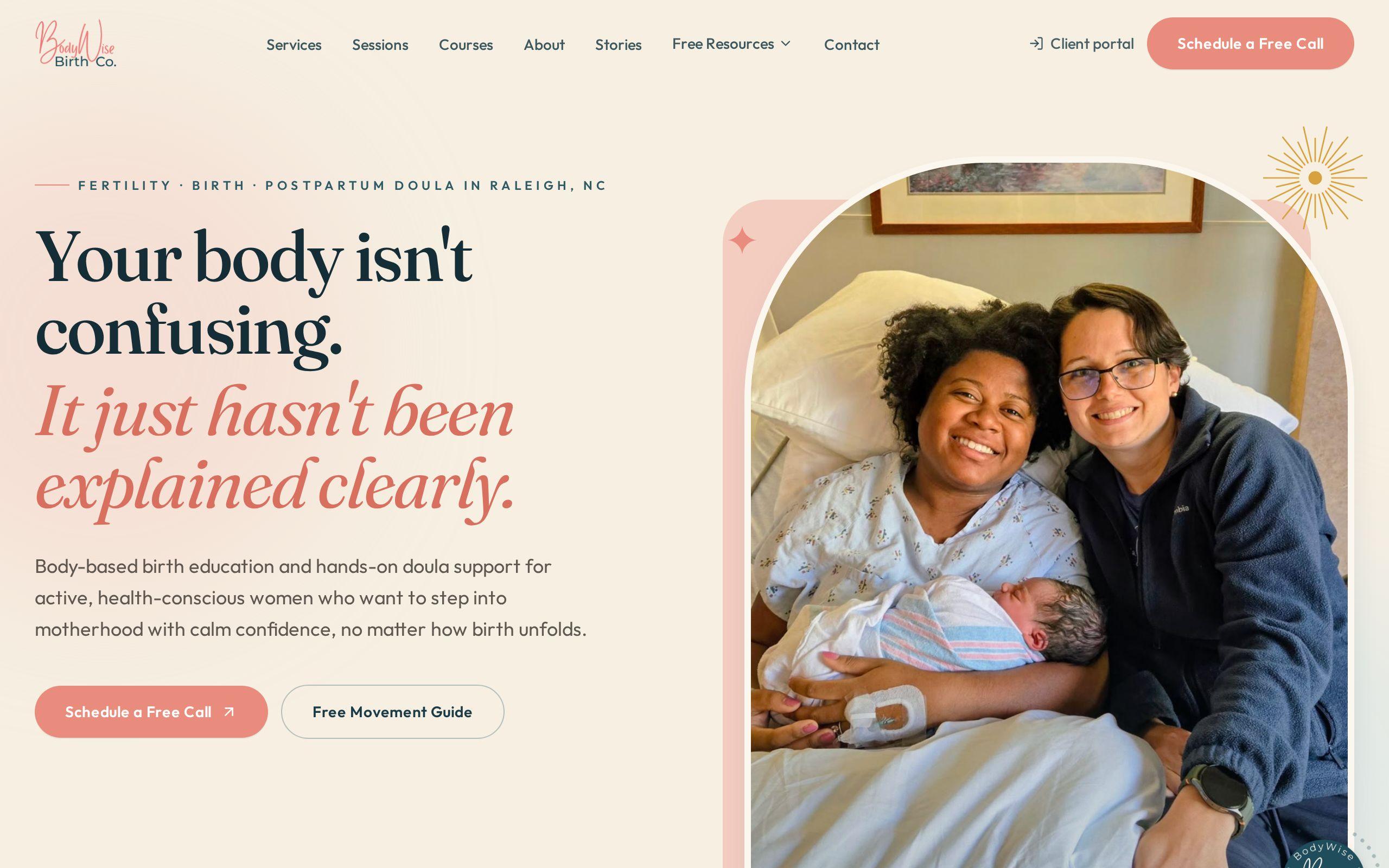
A doula asks someone to let a near stranger into one of the most vulnerable days of their life. The site has to do the work of a first meeting before there is one.
BodyWise Birth Co. is a Raleigh doula and reproductive education practice. Here is how its site handles that problem, and what any practitioner can borrow.
Why does a doula have to prove experience before the first meeting?
Because the buyer cannot test the product first. A parent can't sample a delivery room.
Most doula websites fall into one of two ditches. They read like a clinical brochure, all credentials and service lists. Or they read like a personal blog, warm but hard to evaluate. Neither convinces an expecting parent to book someone they have never met.
What the parent is really asking is simple. Has she done this before? Does she know the places I will be? Will she be calm when it counts?
"I have ten years of experience" is a claim. Anyone can type it. The site needs evidence a stranger can check with their own eyes.
What did the BodyWise brief ask the site to do?
Three things at once.
First, feel like Tara in the room: calm, direct, and unafraid to say plainly what a body is doing. Her manner is the product an expecting parent is actually evaluating.
Second, hold three services with three different customers. BodyWise spans fertility charting, birth support, and postpartum recovery. A person charting their cycle is not the same visitor as someone eight months pregnant.
Third, lead with the founder's educational philosophy rather than a services list.
Inside that brief sat one pair of decisions about proof. Show real birth stories. List the hospitals and birth centres attended. Together they turn a decade of experience into something visible. You can see the full project on the BodyWise case study page.
Why do real birth stories persuade better than testimonials alone?
A testimonial says "she was wonderful." A birth story shows what wonderful looked like at hour fourteen.
Testimonials are short and, honestly, interchangeable. Every business has a page of five-star sentences. A visitor skims past them the way they skim past a hotel's own reviews.
A story is specific. It has a setting, a turning point, and a person who stayed steady. It lets a reader picture themselves in the scene and picture the doula next to them.
Stories also answer the fears a testimonial can't touch. What if the plan changes? What if it goes long? What does support actually look like when things get hard?
Keep the testimonials. They are quick and useful. But let the stories carry the weight.
How does a full roster of Triangle hospitals and birth centres build confidence?
Because it answers a question every client has and few ask out loud: does she know where I'm giving birth?
A doula who has worked in a particular hospital knows its rhythms. She knows where to park and who to ask. A family reading a roster that includes their hospital or birth centre relaxes. Someone in the Triangle expects a Triangle doula to know the local places.
The roster does a second job. It shows range. A long list of venues tells a stranger that this is a working practice with real history, not a new site with a good logo.
Notice what it avoids. It makes no promise and quotes no number. It simply names places. Specifics are what make a claim believable.
A short list that stays current beats a long list nobody checks. Update it when the practice changes.
How does naming the places she serves help local search?
People search the way they live. A family does not search "doula." They search for a doula near the hospital where they plan to deliver, or in their town.
BodyWise names the Raleigh and Triangle towns and the birth venues she serves, so local search can connect her to the places families actually give birth. A page that mentions those places in plain language gives search engines something concrete to match.
The same content that reassures a nervous parent also tells Google where the business works. That is the best kind of SEO: no extra copy, no tricks, just real facts stated clearly.
If you want help making that kind of local relevance deliberate, it is the core of our SEO and analytics work.
Where do stories and the roster sit relative to the discovery call?
Right beside it, never in its way.
Every section of the BodyWise site routes toward a single action: the free 30-minute discovery call. Stories build trust. The roster builds familiarity. Then the call lets the parent meet Tara without risk or cost.
Think of the order as a ladder:
- Read a story. The visitor sees how she works.
- Check the roster. The visitor sees she knows their place.
- See the starting prices. BodyWise publishes starting-point pricing for each package, which removes the uncertainty that keeps many families from reaching out at all.
- Book the call. Scheduling and a client portal are wired into the site, so booking never leaves it.
Proof without a next step is just decoration. The call gives every piece of proof somewhere to go.
How do the three paths keep each visitor in their own stage?
The offer is split into three clear paths: education, pregnancy and birth, and postpartum.
A visitor at any stage finds their own door without reading the others. Someone charting their cycle never has to wade through postpartum recovery. Someone six weeks from their due date doesn't need a lesson in fertility.
This matters for the proof, too. Stories and the roster speak most directly to the birth path, so that is where they live in the visitor's mind. Each path can ask for the same single action while talking in the language of its own stage.
There is also a free-resource library, with a movement guide and downloadable birth-planning PDFs. It lets someone earn trust and share an email address long before they are ready to book. Not everyone is ready for a call on the first visit, and the site doesn't pretend they are.
What should you keep in mind when sharing client stories?
Stories are powerful because they are real. That is also why they need care.
- Get clear permission. Ask before publishing, and make it easy for a client to say no or change their mind.
- Let the client decide the details. Names, photos, and identifying specifics are theirs to share or withhold.
- Leave out what doesn't serve the reader. A story can be honest without including every medical detail.
- Be fair to the hospital and the care team. Showing your work is not the place to settle scores.
- Tell the hard stories honestly. A plan that changed, handled well, can be more reassuring than a perfect day.
Rules around health information vary by situation, so if you are unsure, talk to someone qualified before you publish.
What can another practitioner copy from this approach?
You do not need to be a doula. Any practice that sells trust to a stranger can use the same moves.
- Replace "years of experience" with evidence a visitor can see.
- Name the specific places, towns, and institutions you work with.
- Give every proof point one clear next step.
- Split your offer by the visitor's stage, not your internal org chart.
- Publish starting prices so cost is not a silent barrier.
We build this kind of structure through custom web development, and the thinking carries over to any local service business.
Your next step: open your own site and look for one thing a stranger could verify about your experience. If you find only adjectives, write down three real places you have worked and one story you could share with permission. That list is your first draft. If you'd like a second pair of eyes on it, start a conversation with us.