
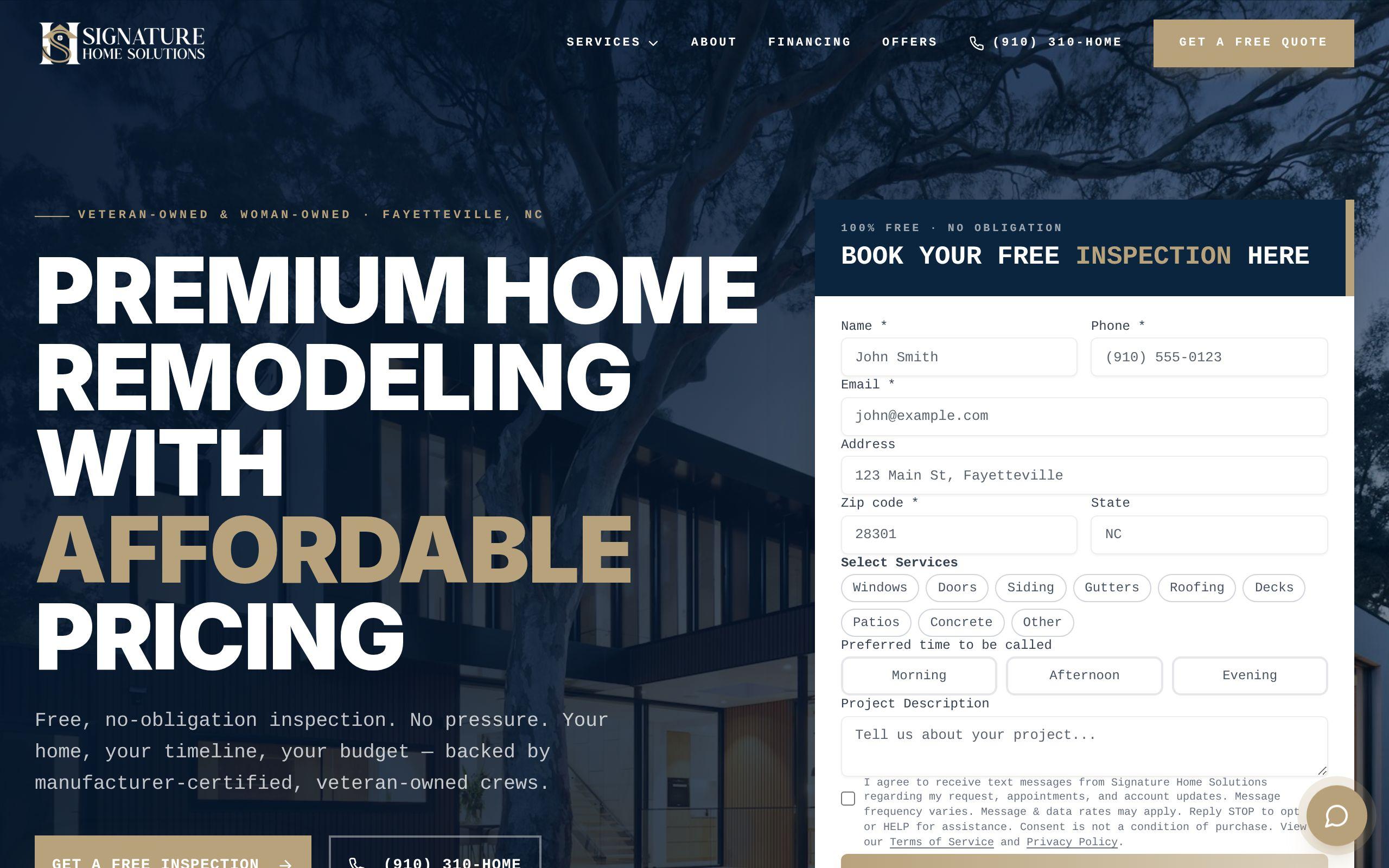
Should there be an estimate request button on every page of a home improvement website? For most contractors in Raleigh and the Triangle, yes. But the button is the small part of the answer. The decision behind it is the interesting part.
Signature Home Solutions gave us a clean test of the idea. Here is what we decided, why, and where the approach stops working.
Why does one contact page fail a company with jobs of every size?
A homeowner with a leaking faucet and a homeowner planning a whole-room remodel are not the same buyer. They want different things from your website.
The faucet person wants speed. A long form feels like paperwork, and they will close the tab.
The remodel person wants to feel considered. A two-field form feels like you did not take the project seriously.
A single generic contact page, tucked into the navigation, serves neither. It asks every visitor to hunt for it, then hands everyone the same experience.
What did the Signature Home Solutions brief ask for?
Signature Home Solutions is a full-service home improvement company. The work runs from small repairs to whole-room remodels, so the inquiries do too.
The brief came down to one job: route a wide range of inquiries into one pipeline. Small jobs should not feel like paperwork. Large jobs should not feel unconsidered.
That is a harder problem than "make it look professional." It is a routing problem, and it shaped every choice after it. You can see the finished result on the Signature Home Solutions case study page.
Why is the estimate request the primary action on every page?
We designed the estimate request as the primary action on every page. Not a destination buried in navigation.
The reasoning is simple. Buyers do not decide to call at a scheduled moment. One reads a kitchen page and thinks, "I'm ready." Another reads a gutter repair page and thinks the same thing, thirty seconds in. If the next step is two clicks away, some of them never take it.
A persistent estimate action means the moment of intent always has somewhere to go.
It also changes how you think about pages. A page is no longer an article that happens to sit on a site. It is a step toward a booked estimate, and it should behave like one.
How does the service range help visitors find their own job?
A persistent button only works if the visitor knows they are in the right place. That is what the service structure is for.
We organized the service range so visitors can find their specific job. We did not give them a catch-all list to read through.
Think about what a catch-all list says: "We do a lot of things, good luck." A homeowner scanning it has to decide whether their problem is covered. Some will guess wrong and leave.
When a visitor lands on a page that names their job, the estimate request stops being a leap. They are not asking a stranger to figure out what they need. They are asking this company to look at the thing the page just described.
Why does trust come before price for home improvement buyers?
Contractors often assume the homepage should lead with price. It rarely should.
A homeowner is letting someone into their house. Before they compare numbers, they are asking whether this company is real, careful, and likely to show up. So we built trust-first layouts.
In practice, that means the page earns confidence before it asks for anything big. The visitor sees who they are dealing with and what the work looks like. Then the estimate request arrives, already sitting there, when they are ready.
Notice the order. The button is always present. The trust is what makes pressing it feel safe. Those two things work together, and neither works well alone.
Why did a booked estimate become the success metric?
We tuned the whole flow for conversion volume, and we treated a booked estimate as the success metric.
That choice sounds obvious. It is not how most sites are judged. Plenty of contractor sites get measured on traffic, rankings, or how nice the gallery looks. None of those pay a crew.
A booked estimate is the point where a stranger becomes a real conversation. Everything on the site either moves a visitor toward that or does not.
Picking one metric also ends arguments. Should the hero image be bigger? Should the services be reordered? Ask which version books more estimates, and test it. If you want help with this kind of work, it falls under our custom web development practice, alongside conversion optimization.
When does a persistent estimate button get in the way?
We would be doing you a disservice if we said it always helps. It does not.
A persistent estimate action can annoy a buyer in a few cases:
- The button is loud and the page is not. If a visitor is still reading about your process, a banner shouting "Get your estimate" feels pushy.
- It covers content. A sticky element that blocks the text on a phone is a tax on every visitor.
- It asks for too much. A button that opens a long form on a small repair page repeats the original problem.
- It is the only thing on the page. If there is no information to build trust, the button looks desperate.
The fix is not removing the action. It is matching its weight to the page. Keep it present, keep it calm, and keep the ask proportional to the job.
How can you audit your own pages for a clear next step?
Open your five most visited pages. For each one, answer three questions.
- What should a visitor do next? If you cannot say in one sentence, the page does not have a job.
- Can they do it without scrolling or searching? If the estimate request lives only in the menu, you have the original problem.
- Does the page earn the ask? Is there enough about who you are and what you do to make requesting an estimate feel reasonable?
Then pick the page with the weakest answer and fix that one first. Trying to redo the whole site at once is how projects stall.
If your site is slow, visitors may leave before any of this matters. Run it through our speed test to find out. And if you are a builder or remodeler specifically, our page on contractor website design covers how we approach it.
What should you do this week?
Pick one service page on your site. Read it as a stranger with that exact problem. Then ask whether an estimate request is within reach at the moment they would want it.
If it is not, that is your first change. If you would like a second set of eyes on it, get started here.