
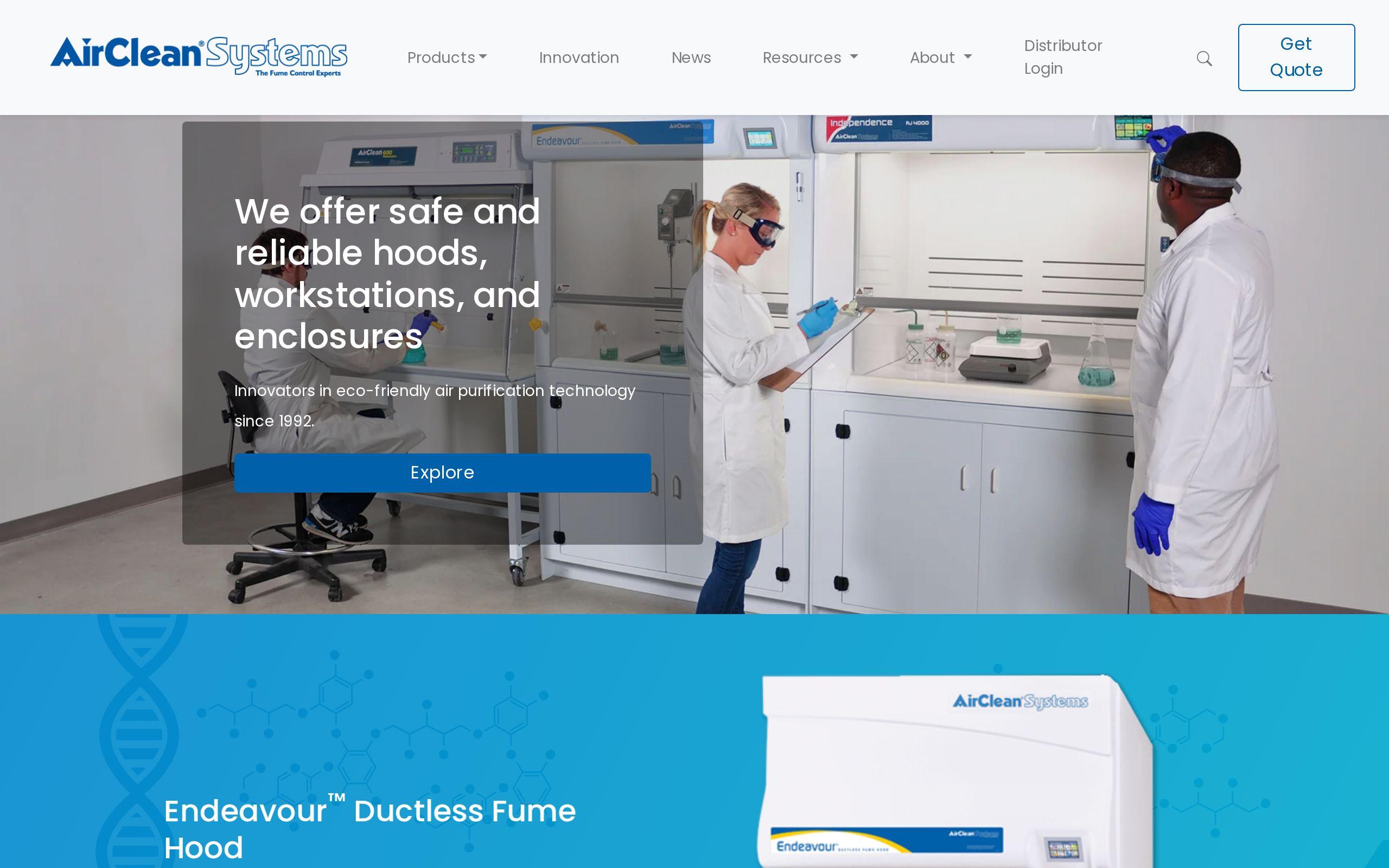
Some businesses have one customer. Air Clean Systems has two, and they have almost nothing in common.
One is a homeowner with a question about their house. The other is a facility buyer running a procurement process against specifications. Same company, same products in some cases, completely different way of buying.
This is how the site we built for them handles that, and what you can borrow if your business has the same split.
Why does one contact form fail a business with two kinds of buyers?
Because a form is a set of questions, and each buyer wants a different set.
Make the form short and friendly, and the commercial buyer has to write an email to explain what they actually need. Make it thorough, and the homeowner leaves before the second field.
You end up with a compromise. In the words of our own brief for this project, serving both from one site usually produces a compromise that converts neither.
The form is only where the problem shows up. The cause sits earlier, in a site that treats two buyers as one audience.
The brief: a homeowner's quick answer versus a procurement process
Here is the situation Air Clean Systems brought us. Two buyers, two ways of buying:
- The homeowner wants a quick answer about their house.
- The commercial buyer is working through a procurement process, measuring options against specifications.
On top of that, the product range had to stay navigable for both at the same time. Nobody wanted a site that made a homeowner wade through commercial systems, or made a facility manager dig for the right category.
That is a design brief, a content brief and a lead capture brief all at once. We handled it with custom web development and conversion work, not a theme and a contact plugin.
Splitting the paths so each buyer self-sorts at a glance
The first decision was to stop pretending there is one visitor.
We split the paths so residential and commercial buyers each get a route that matches how they buy. The key word is route. It is not a pop-up asking "Who are you?" It is a clear fork, early, where each buyer recognizes themselves.
Self-sorting works when the labels are plain. A homeowner knows they are a homeowner. A facility buyer knows they are buying for a facility. Nobody has to decode your org chart.
Once someone picks a path, everything after it can assume who they are. The copy, the product emphasis and the form can all be written for one person instead of two.
What a homeowner is asked, and why it stays short
The homeowner path exists to get a quick answer. So the form has one job: collect just enough for someone to reply usefully.
The principle is simple. Every field you add costs you some people. A homeowner asking about their house is not going to fill out a document, and they should not have to.
Think about what a person at the company needs to start a conversation. Who is this, how do we reach them, and what is the question about their home? That is the territory a residential form should stay in.
Anything else can wait for the conversation. Details are easy to ask for once someone has replied and shown they are real. They are hard to extract from a stranger on a first visit.
What a specification-driven buyer needs to hand over
The commercial inquiry runs the other way.
A buyer running procurement against specifications is not browsing. They are comparing, and they expect to be asked for detail. A thin form can actually look unserious to them, because it suggests nobody will read the answers.
That is why we tuned lead capture separately for each audience. The two inquiries need different information, and the commercial one needs the facts that let the company respond to a real requirement rather than starting with a round of clarifying questions.
The tradeoff is deliberate. The commercial form can ask for more because the buyer arrives with the answers already in hand. They are willing to share them if it gets them a better first reply.
Organizing product categories so the right system is easy to reach
A form only helps if the buyer reaches the right place first.
For a specification-driven buyer, that means product categories organized so they can navigate to the right system. They are looking for a match against a requirement. If the structure forces them to guess where a system lives, the inquiry never starts.
This is where many product sites quietly lose commercial buyers. The catalog grows by accident, one page at a time, and the structure ends up reflecting the company's history instead of the buyer's search.
Here, the range had to stay navigable for both audiences at once. Category structure is how that gets done without turning the homepage into a warehouse.
Leading with capability instead of company history
Look at the average "About" section on a contractor or services site. It opens with the founding story.
Buyers rarely start there. They want to know whether you can do the job.
So the layout is service-forward. It leads with capability rather than company history. Someone arriving from either path sees what Air Clean Systems does before they see where it came from.
That helps the lead form too. A visitor who has just seen relevant capability is a visitor with a reason to start a conversation. The form then feels like the next step, not a toll booth.
The history is still available for the buyer who wants it. It just does not stand between a buyer and an answer.
What this case study does not claim
We are keeping this honest. This post describes decisions: what was built and why. It does not report conversion numbers, lead counts or revenue, because those are not part of what we are documenting here.
What we can say is that the reasoning holds up. Different buyers, different questions, different paths. If you want the project summary, the Air Clean Systems case study has the headline facts and the live site.
How to copy this split on your own site
You do not need Air Clean Systems' product range to use the same approach. If your business sells to two kinds of buyers, here is the short version.
- Name your two buyers. Write down how each one buys. Fast and personal, or slow and specification-led.
- Fork early. Give each a clearly labeled route on the homepage, in words they would use themselves.
- Write each form for one person. Keep the quick-answer form short. Let the procurement form ask for what a real quote needs.
- Fix your categories. If a technical buyer cannot find the right system, no form will save you.
- Lead with what you do. Put capability before history.
Then test it as each buyer. Fill out both forms on your phone and ask honestly whether you would finish them.
Your next step: open your current contact form and list every field. Next to each one, write which buyer needs it. Any field that only one buyer needs is a sign you should have two forms. If you want a second opinion on the split, start a conversation with us.