Construction software has a reputation to overcome. Most owners and project leads have lived through a rollout that promised a lot and delivered a login nobody used.
So when a platform asks for a demo, the buyer's first thought is not "great." It is "what are we getting into?"
That was the problem behind the Construxos site. Here is how we handled it, and what you can borrow if you sell software to people who have been burned before.
Why do construction buyers want to see the product before booking a demo?
A demo costs the buyer something. It costs an hour, a conversation with a salesperson, and the risk of being followed up for weeks afterward.
Construction buyers are practical. They judge tools by whether the tool works on a real job, not by how it is described. Scepticism is the sensible default.
That changes what a SaaS website with product preview before demo has to do. The site cannot just describe the platform and ask for trust. It has to let the buyer look first, on their own time, with no one watching.
What did the Construxos brief ask the site to carry at once?
Construxos is a construction technology platform with tiered products. The brief had two jobs that pull in opposite directions.
First, show the product working before anyone commits to a demo.
Second, explain who each tier is for, without turning the marketing site into documentation.
Add a third job on top: a full brand identity, because the platform was selling into a conservative industry and needed to look like something a careful buyer could trust.
Show more and the site becomes a manual. Explain less and buyers stay sceptical. The work was finding a structure that carried all three without strain.
How do portal previews answer questions a feature list cannot?
A feature list says what exists. It does not say what it feels like to use.
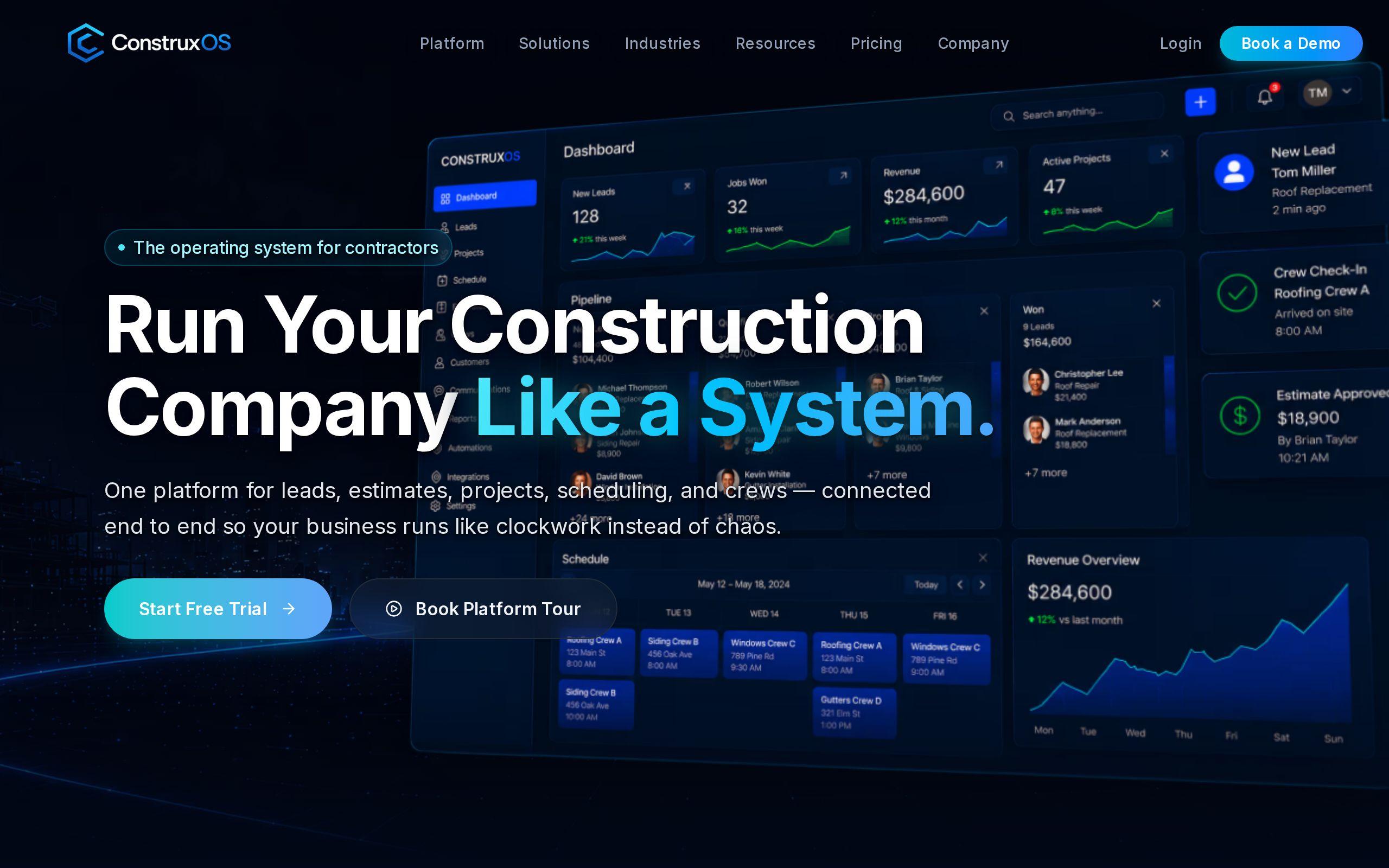
For Construxos we designed client-portal previews, so prospects can see the platform before committing to a demo. The buyer gets a look at the thing they would actually be working in.
That matters for a few reasons:
- It replaces a claim with evidence. "Easy to use" is a sentence anyone can write. A preview is harder to fake.
- It lets buyers self-qualify. Someone who sees the portal and thinks "this is what we need" arrives at the demo ready. Someone who does not saves everyone an hour.
- It lowers the cost of curiosity. Looking is free. Booking is not.
The preview is not the sale. It is the reason the buyer says yes to the next step.
Why does each product tier get its own page and its own buyer?
Tiered products tempt you into one big comparison table. It looks tidy. It also asks every visitor to decode which column is theirs.
We built tiered product pages that let each plan make its own case to its own buyer. Each tier speaks to the person who would actually choose it, in the terms that person uses.
A buyer on a smaller plan does not need to wade through everything the larger plan does. A buyer on a larger plan should not have to guess whether the smaller one is a toy.
Separate pages also keep the site from sprawling. Each one answers a single question: is this the right tier for our team? Then it points at the next step.
How is the brand identity built for a conservative industry?
Construxos needed a complete brand identity, and the audience shaped every choice.
In a conservative industry, a brand has one job before any other: look like it will still be here next year. Buyers are signing off on tools their crews will rely on. A brand that feels flashy or fragile works against the sale.
That is why identity and site belong together, not one after the other. The brand sets the tone, and the portal previews and tier pages carry it onto real screens. A buyer who sees a steady brand and a working product reads both as the same signal: these people know what they are doing.
If your customers are cautious, your brand should be a reason to relax, not another thing to evaluate.
Why is the demo signup the only conversion event on every page?
Every page on the Construxos site is structured around the demo signup. We treated it as the single conversion event that matters.
That is a decision, and it means saying no to tempting options. No pile of secondary buttons splitting attention. No side doors out of the story.
Here is the logic:
- Previews build confidence, and confidence needs somewhere to go.
- Tier pages narrow the buyer to a plan, and that narrowing needs somewhere to go.
- The brand earns trust, and trust needs somewhere to go.
All three should arrive at the same place. When a page has five possible next steps, the buyer often picks none.
What would we tell another SaaS owner to copy, and what to skip?
Copy these:
- Show the product before you ask for the meeting. A preview does the persuading your copy cannot.
- Write each tier for the buyer who would choose it.
- Pick one conversion event and build every page to serve it.
- Build the brand with the site, not before or after it.
Skip these:
- Previews that tour every screen. Show enough to build confidence, then stop.
- Tier pages that repeat the same copy with different prices.
- A second "soft" call to action that quietly competes with the demo.
Your product is different from Construxos, so your preview will be different too. The principle holds: let the buyer look before you ask them to commit. You can read the full project on the Construxos case study page.
How do you know whether a preview is helping or just adding length?
A preview earns its place if it moves buyers toward the demo signup. If it only makes the page longer, cut it.
Ask a few plain questions:
- Do visitors who see the preview go on to sign up for the demo, or do they leave from the preview?
- Do demo calls start with better questions than they used to?
- Does your sales team spend less time explaining the basics?
If the answers are no, the preview is decoration. Tighten it, move it, or replace it with something that answers a real objection.
This is also why the build matters. Previews that load slowly or break on a phone at a job site do the opposite of their job. If you are weighing a build like this, our custom web development work covers it, and our SaaS website design page shows how we approach the category.
What to do this week
Write down the three questions a sceptical buyer asks before they book a demo with you. Then open your site and check whether a stranger could answer each one without talking to anyone.
Wherever the answer is no, you have found your first preview.