
If you run a marketing agency, your website is the one pitch every prospect sees before they talk to you. It is also the hardest brief you will ever take on.
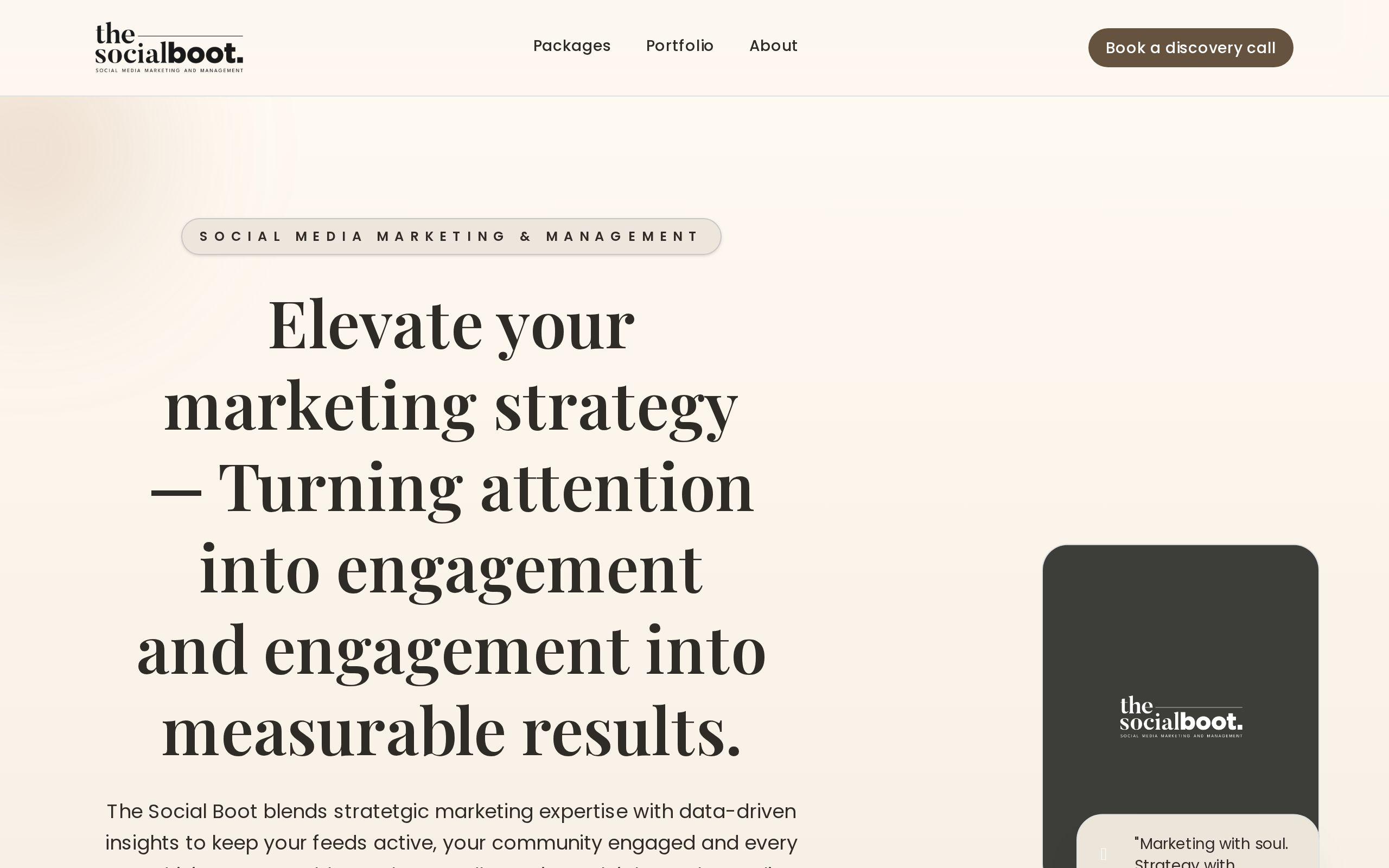
We built the site for The Social Boot, a digital marketing agency. One decision on that project is worth a closer look: booking lives on the site, right next to published pricing tiers. Here is the reasoning, and what you can borrow.
Why does booking belong on a marketing agency's own site?
Because the site is your proof. An agency that sells growth for other people should not make its own prospects work to reach it.
Think about what a visitor does when they like what they see. They are interested right now. A contact form that promises a reply "soon" turns that interest into a waiting game. Booking on the site turns it into an appointment.
The agency website is also a live demo. If you tell clients that a clear path from interest to action matters, your own site had better have one. Your marketing agency website booking a discovery call is the cheapest, most honest case study you own.
What the brief asked for: capable, direct about price
The Social Boot needed to look unmistakably capable to small and mid-size business owners. It also needed to be direct about price, which most agencies avoid entirely.
Those two goals pull on each other. Looking capable usually means polish and mystery. Being direct about price means showing your hand.
The agency's position was clear. Vague pricing filters out exactly the self-serve buyers it wanted. Owners who like to research, decide, and move on will not fill out a form to ask what something costs. They leave.
How published tiers and booking work together
Each piece does a different job.
- Pricing tiers let a prospect qualify themselves. They see the shape of the offer and decide whether it fits their budget before anyone speaks.
- Booking gives the prospect who says yes a next step they can take immediately.
Alone, tiers give people information and nowhere to go. Alone, a booking button asks people to commit to a call without knowing the range. Together, they make a short path: read, decide, schedule.
The first conversation also changes. Nobody spends the first ten minutes circling the question of money. Both sides already know the neighborhood.
Why removing back-and-forth matters to small-business buyers
A small-business owner is usually the marketer, the accountant, and the person who unlocks the door. Their attention comes in small pieces.
Every email exchange to find a time is a chance for the lead to go cold. "Does Thursday work?" sits in an inbox next to a hundred other things. By the time it gets answered, the owner may have moved on to the next agency, the one with a calendar.
Built-in booking removes that gap. The prospect picks a time while they are looking at your work. No thread, no waiting, no chasing.
What we built and what we left out
For The Social Boot, we built a bold brand identity, a website, published pricing tiers, and booking integrated into the site. The services behind it were brand strategy, brand development, web design, and custom web development. You can see the full write-up on the Social Boot case study page.
What we left out matters as much.
- Enterprise language. The site speaks to small and mid-size owners in plain terms, not the corporate phrasing agencies default to.
- Interchangeable looks. Most agencies look alike. The identity had to be distinct enough to survive in that category.
- Mystery pricing. No "contact us for a quote" wall between the visitor and a basic answer.
Every one of those cuts made the site more selective. That is the point. A site that tries to appeal to everyone convinces no one.
Where can a booking step go wrong?
Publishing prices and adding a calendar is not risk free. Be honest about the trade-offs.
Tiers can scare off some people. Some visitors will see the price and leave. If they were never going to buy, that is a fast, free filter. If your tiers are badly explained, you lose people who would have said yes.
Competitors can read your prices. They can. They can also read your portfolio. Clients rarely choose an agency on price alone.
A booking step can feel like a trap. If the page asks for too much before showing a time, or never says what the call is for, visitors hesitate. Say what happens on the call and keep the steps few.
A tier can overpromise. Tiers need to describe real work. If a package can't be delivered at the stated level, the call starts with an apology.
What can a small agency copy this month?
You do not need a rebuild to start. Try this list.
- Write your tiers down. Even rough ones. Name what each includes and who it is for.
- Put one booking action on the page. Not three competing buttons. One.
- Say what the call covers. One plain sentence: who is on it, how long, what the visitor leaves with.
- Cut the enterprise voice. Read your homepage out loud. If a local café owner would squint, rewrite it.
- Test it yourself. Go from your homepage to a scheduled call on your phone. Count the taps. Our speed test is a good first check on whether the page loads fast enough to keep people there.
How this fits the rest of the site
Booking and pricing only work if the surrounding site earns trust. The identity has to look capable. The copy has to sound like it was written for the reader. The pages have to load and behave.
That is why the brand work and the build happened together on this project. If you want the technical side, our custom web development service covers how we build sites like this. If your agency's identity is the weaker link, brand development is where we would start.
Your next step
Open your own site on your phone and try to book a call with yourself. Time it. If it takes more than a minute, or you can't tell what the call costs or covers, you have your first fix. When you are ready to talk it through, you can start at /get-started.