
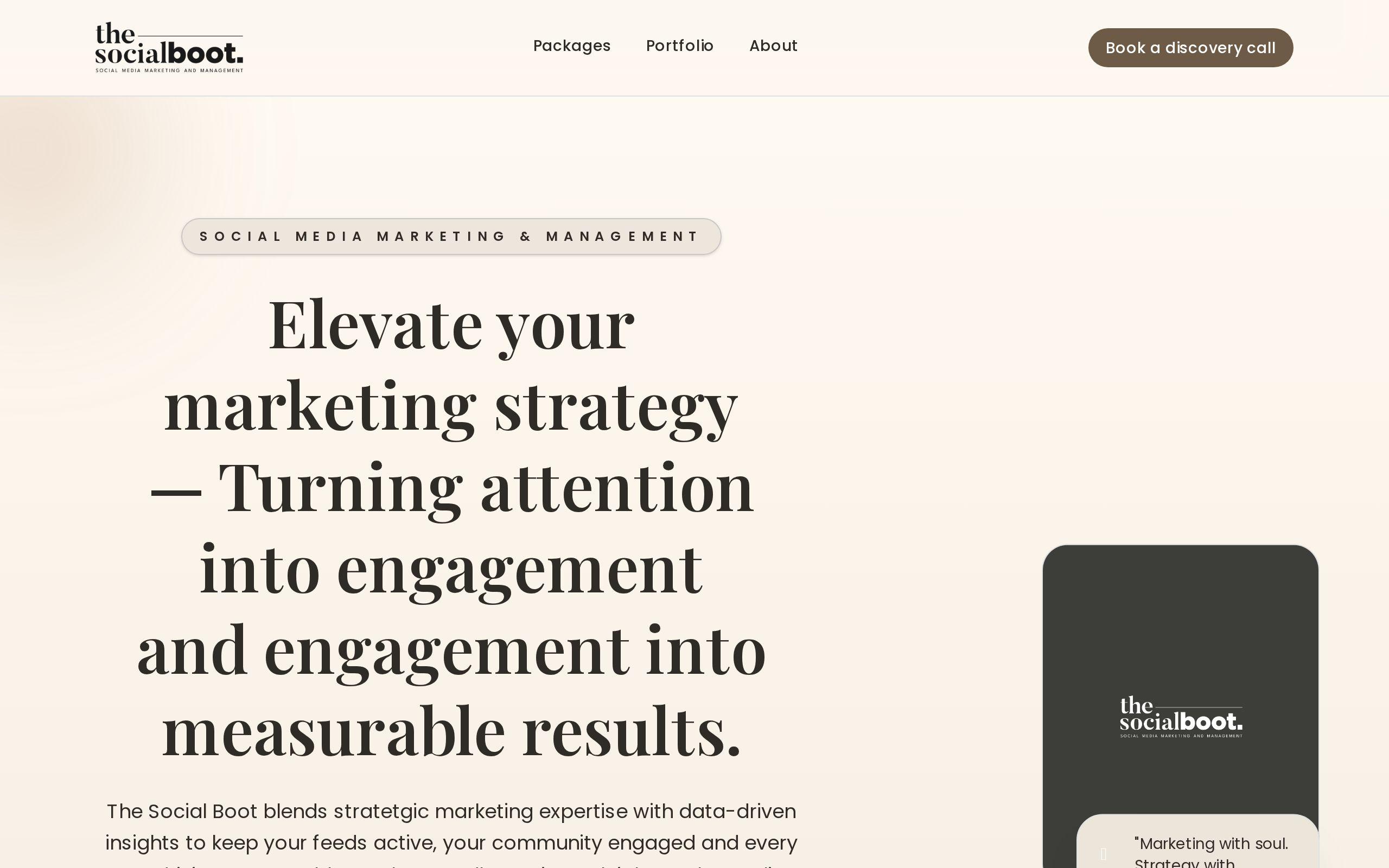
Should a marketing agency publish pricing on its website? Most say no. The Social Boot said yes, and we built the site that way.
Here is the decision, the trade-offs, and what it means if you run a service business in Raleigh or anywhere else in the Triangle. The full project is on the case study page.
Why do most agencies hide their prices?
Fear, mostly. A published number can be compared. It can be screenshotted. It can scare off someone who might have been talked into a bigger package on a call.
So the default is a contact form and a line about "custom solutions." The pitch is simple: get them talking, then size up the wallet.
That default has a cost. The buyer who wants to evaluate you quietly, on their own time, hits a wall and leaves. Vague pricing filters out exactly those self-serve buyers.
What was The Social Boot trying to achieve?
The Social Boot is a digital marketing agency. It came to us for a brand identity and a website.
An agency's own site is the hardest brief it will ever take. The site is the proof of what the agency sells. If it looks generic, the pitch is generic.
The goals were specific:
- Look unmistakably capable to small and mid-size business owners.
- Be direct about price.
- Make it easy to get from interest to a conversation.
Those three goals pull in the same direction. That is why the site works as a system and not a collection of pages.
How do published tiers let buyers qualify themselves?
A buyer lands on the site. They see the tiers. In a minute or two they know whether this agency is in their range.
If it is, they arrive at the first conversation already informed. The call skips the awkward budget dance and starts with their goals.
If it is not, they leave without taking an hour of anyone's day. Nobody feels misled. Nobody sat through a pitch for something they could not afford.
Self-qualification is the whole mechanism. The site does the first screening so the team does not have to.
What does clear pricing filter out, and is that a good thing?
Some buyers, by design. Let's be honest about who.
- Shoppers who want to be quoted a number only after a long pitch.
- Anyone whose budget sits outside the published tiers.
- Buyers who prefer the agency to guess what they will pay.
That sounds like lost business. We would call it saved time.
The Social Boot wanted self-serve buyers, the ones who read, decide, and then book. A vague price page turns those people away. A clear one welcomes them. You lose some conversations and gain better ones.
Our position: if a prospect cannot work with your price, you want to find out on the website, not on the third call.
How does built-in booking remove back-and-forth?
Interest is perishable. A buyer who is ready to talk at 9 p.m. does not want to send an email and wait for a reply tomorrow.
The site has booking integrated directly into it. A visitor who likes what they see can schedule a call right there. No form, no wait, no thread of "does Thursday work?"
That removes the gap between interest and a scheduled call. And it pairs naturally with published pricing. Tiers answer "can I afford this?" Booking answers "what do I do next?" Put them on the same site and the path is short.
How did the brand identity support a direct approach?
Directness needs a voice that can carry it. A timid brand that suddenly posts prices looks nervous. A bold one looks sure of itself.
We built a bold identity for The Social Boot, distinct enough to survive in a category where most agencies look interchangeable. That matters more than it sounds. If a buyer has looked at five agency sites and all five blur together, the one that is visibly different gets remembered.
The identity and the pricing do the same job. Both say: we are not hiding anything, and we are not like the rest. If you are weighing a similar move, our brand development work starts from exactly that question.
How did writing for small and mid-size owners change the copy?
Agencies drift toward enterprise language. Big words, big frameworks, big promises. It sounds impressive and it reads like it was written for a procurement department.
The Social Boot's buyers are small and mid-size business owners. So the site was designed for them specifically, rather than in the language agencies default to.
In practice that means plain words, a clear offer, and a price a person can act on. The owner of a growing local business does not want to decode a pitch. They want to know what they get, what it costs, and how to start.
Specific copy is also a filter. It tells the right reader "this is for you" and tells everyone else to move along.
What can your own business borrow from this?
You do not need to be an agency. The logic travels to any service business that sells by quote.
Try this:
- Count how many first calls open with a price conversation. If it is most of them, your website is leaving work to the phone.
- Publish a range or tiers. Say what is included. A buyer should be able to place themselves.
- Put booking on the page. Let the ready buyer schedule without writing to you first.
- Write for the owner you actually want. Cut the language aimed at buyers you do not serve.
- Accept the filtering. Some people will leave. Let them.
If your own market is crowded with look-alikes, the same thinking applies to creative agency websites and plenty of other industries.
Your next step
Open your site on your phone and try to answer two questions in under a minute: what does this cost, and how do I book? If either takes longer, that is your to-do list. And if you want a second opinion, start a conversation with us.