
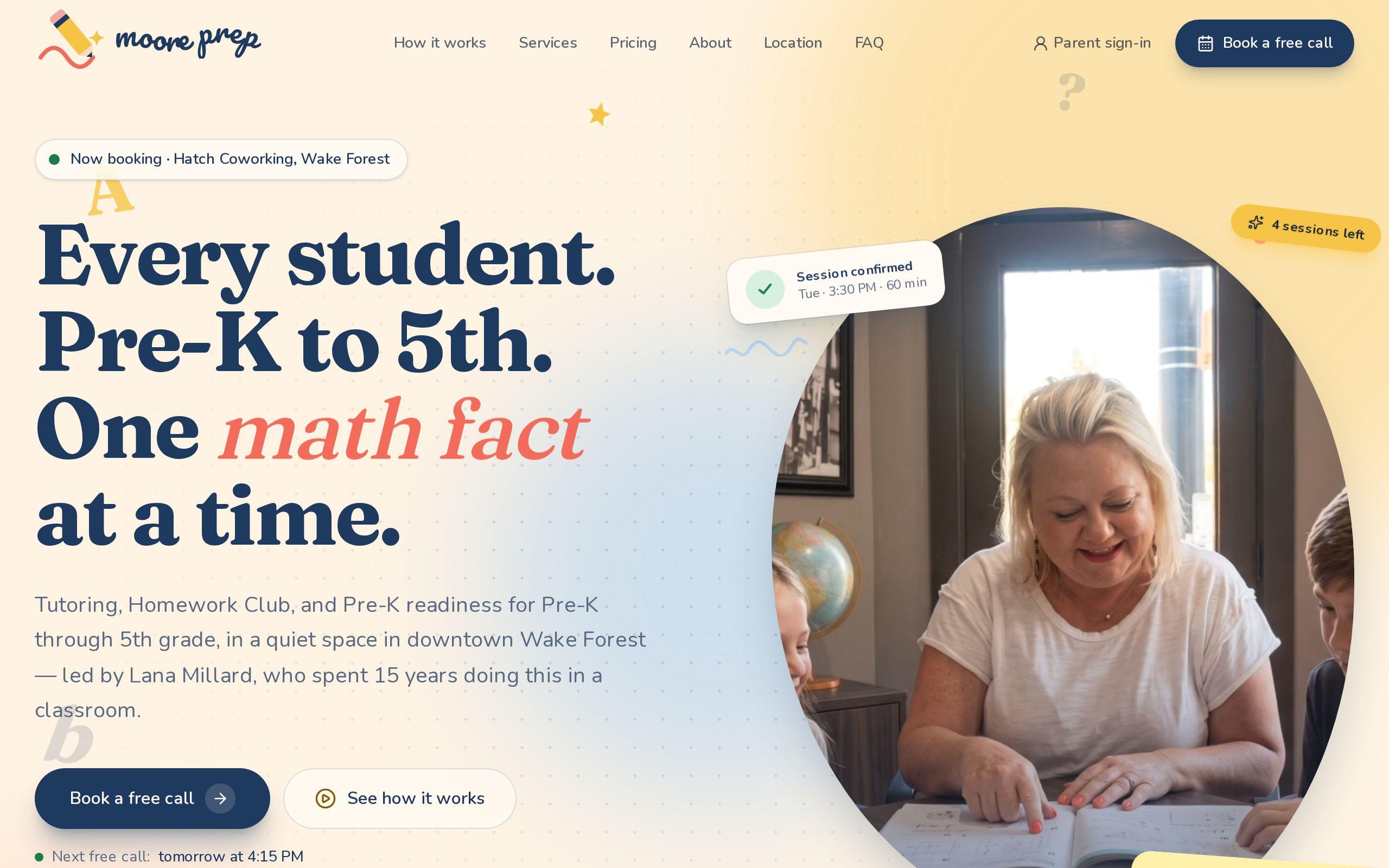
Moore Prep is one educator, Lana Millard, working with children in a small room at Hatch Coworking in downtown Wake Forest. This is how we rebuilt its site around that fact, and why the main decision was to make a conversation the only way in.
If you run a small practice and are weighing free consultation booking for a tutoring website, the details here are the useful part. Not the template. The reasoning.
Why did Moore Prep's first site describe a business that did not exist?
The first version read like a small private school. It listed six programs. It had a tour scheduler. It showed classroom imagery.
None of that was real. There was no campus to tour and no six-program catalog. There was a teacher, a quiet room, and children who needed patience.
A parent who arrived expecting a school would be confused on the first visit. A parent who needed a gentle tutor might leave, assuming this was not the place.
So the rebuild started with an honest inventory. One teacher. Three services: Tutoring, Homework Club, and Pre-K Readiness. One room.
What changes when the site matches the room?
Parents are trusting a stranger with a child who is struggling. The site has to feel like a quiet room and a patient teacher. It should not feel like a learning-center franchise.
That tone is a design decision, but it is also an honesty decision. Every claim on the page is one Lana can keep.
If your site describes a bigger business than you run, you will spend your first conversations correcting it.
Why make a free 15-minute call the only way in?
Because Lana is one person, and so is her inbox.
A typical tutoring site offers a contact form, a phone number, a sign-up page, and maybe a trial lesson. Each one sends families down a different path, and each path lands on the same teacher between sessions.
Moore Prep has one door. A free 15-minute call. No family pays for anything before talking with Lana.
That works for both sides:
- Parents get to hear the teacher before spending a dollar.
- Lana meets every family the same way, so she can judge fit before taking on a child.
- The site has one job, which makes it easier to write and easier to follow.
A single entry point is not a limit on a small practice. It is the practice protecting its own time.
How does showing the next open time under the button change the ask?
The button says to book a call. Under it, the site shows the next open time.
That small line changes what the parent is being asked to do. "Get in touch" is open-ended. It asks a tired parent to commit to a process with no visible end. "The next open time is here" is a specific slot they can picture.
It also tells them something quietly. Someone is actually there, and the calendar is real.
Think about the last time you filled in a form and heard nothing back for two days. A visible time says that will not happen here.
Why does booking from Lana's real availability beat a contact form?
A contact form collects a message. Then someone has to read it, reply, propose times, wait, and confirm. That is five steps before a conversation exists.
At Moore Prep, the call is booked from Lana's real availability. The parent picks a time that is actually open, and the call is on the calendar.
For a one-teacher practice, this matters more than it would at a larger business:
- No back-and-forth scheduling between sessions.
- No double booking, because the times come from her real calendar.
- No lead sitting unanswered while she is working with a child.
A form is a request. A booking is a decision, already made.
What do plain per-session prices add before the call happens?
Prices on the page. Per-session rates and bundles, published plainly.
Many tutoring sites hide the numbers behind "contact us for rates." That is a reasonable instinct for custom work. For a practice with set sessions and bundles, it is just friction.
Publishing prices does two things before the call:
- It screens gently. A family who cannot make the numbers work can decide without an awkward conversation.
- It lets the call be about the child, not the price list.
Lana spends her fifteen minutes learning what the child needs. Not defending a rate she could have printed.
Parents also read plain pricing as plain dealing. In a field built on trust, that counts.
How does a one-sentence cancellation rule remove a parent's biggest worry?
Ask a parent what makes them hesitate to book a weekly session. It is often not the price. It is the fear of being stuck: a sick child, a missed pickup, a charge for a session that never happened.
Moore Prep states its rule in one sentence. Cancel 24 hours ahead and the session goes back on the account automatically.
Notice what that sentence avoids. No fee schedule. No exceptions list. No policy page that needs a scroll bar.
It works because the system behind it keeps the promise. Every family's sessions sit on an append-only ledger, so purchases, bookings, cancellations, and refunds always add up. A cancelled session returns without anyone doing arithmetic, and two approvals can never spend the same session.
A rule is only as short as your back end lets it be.
What happens after the call: approval, agreement and the parent portal?
The call is the front door, not the whole house.
If Lana and the family decide to go ahead, the family is approved. Then the parent portal takes over. Inside it, an approved family can:
- Sign the parent agreement.
- Buy sessions by card through Stripe.
- Request times, which Lana confirms.
- Share one bundle across siblings.
Order matters here. Money moves only after a conversation and an approval, never before. That is the promise the call makes, and the portal keeps it.
For Lana, the other side is a phone-first back office built for her day: Today, the calendar, requests, payments, the waitlist, and messages. After a session, an assistant can turn her dictated or typed notes into a draft note home. She edits it before anything is sent.
Each child also has goals, notes home, and a progress report the family can share with a classroom teacher by private link. At year end there is a statement for taxes and benefits accounts.
What else supports the quiet-room feel?
A few smaller choices carry the same idea.
The site tells the story of Mason Moore, the boy the practice is named for, in its own section beside the St. Jude giving. It honors him without reading as a memorial.
It names downtown Wake Forest, Hatch Coworking, parking, and hours right on the page. The parent FAQ is marked up as structured data, so local search can answer parents directly.
None of this is flashy. It is a parent in Wake Forest finding out, in a few seconds, that this is a real place with a real teacher.
You can see the full project on the Moore Prep case study page.
What would a similar practice take from these decisions?
Not the layout. The questions behind it.
- Who actually does the work? Describe that person and that room. Cut any program that exists only to look bigger.
- What is the one door? Pick the first conversation you want and send everything to it.
- Is the calendar real? Book from true availability and show the next open time.
- What are parents afraid of? Usually price and cancellation. Answer both in plain words.
- Can your back end keep the promise? A short rule needs a system that enforces it.
If you run a practice like this, the same thinking applies whether you are a tutor, a coach, or a clinic of one. Our tutoring website design work starts with these questions, and the build behind them is custom web development, not a theme.
Where should you start this week?
Open your own site and count the doors. Contact form, phone, trial, sign-up. Then ask which one you would choose if you could keep only one.
Write down the single sentence that would remove your customers' biggest worry. If you cannot write it, your policy is not ready to be a promise yet.
When you are ready to talk it through, start a conversation with us. It will be about your practice, not ours.