
If you own a hauling company, a plumbing shop or a landscaping crew in the Triangle, you have seen it. You search your own service, in your own town, and a national brand sits above you. Maybe it is not even based in North Carolina.
That is irritating. It is also beatable. Here is how to compete with national franchises in local search without matching their budget.
Why do national franchises show up first in local search?
Mostly because they are big. They have an established brand, a lot of links pointing at their domain, and a steady stream of searches for their name. Google reads all of that as trust.
But trust in the brand is not the same as relevance to the searcher. Someone in Cary asking for help today wants a business that clearly works in Cary. Google knows that, and local results lean heavily on distance, relevance and prominence.
You cannot out-brand a franchise. You can out-local one. That is where the opening is.
Where franchise websites are weaker than they look
Open a franchise's page for your city. Now open the page for a city three states away.
Odds are good they are the same page. Same stock photos, same paragraphs, same service list, different place name dropped into the headline. One template serving a hundred cities.
That template is a weakness:
- Thin location pages. A few generic lines and a form, with nothing a customer in your area would recognize.
- Generic copy. It describes the service in the abstract, never the neighborhoods, the housing, the HOA rules or the dump fees people here deal with.
- No real local proof. Stock images instead of crews and trucks on actual streets.
None of that is hard to beat. It just takes effort a template was designed to avoid.
Local proof is the advantage a franchise cannot copy
A franchise can buy ads. It can buy links. It cannot buy the fact that you finished a job on a street in North Raleigh last Tuesday.
Local proof looks like this:
- Photos of your own crew, trucks and finished work, taken in the places you serve.
- Reviews from real customers that mention the neighborhood and the job.
- A page that names the suburbs you actually drive to, and tells the truth about the ones you don't.
- A phone number that rings at a business owned by someone who lives here.
Each of those tells Google and the customer the same thing: this business is really here. A shared national template cannot say it.
Does a family-owned business need to look bigger to compete?
Not bigger. Sharper.
The temptation is to dress up like the franchise: corporate stock photos, vague language about "solutions," a logo that looks like it came from a committee. Skip it. You will lose a look-alike contest every time.
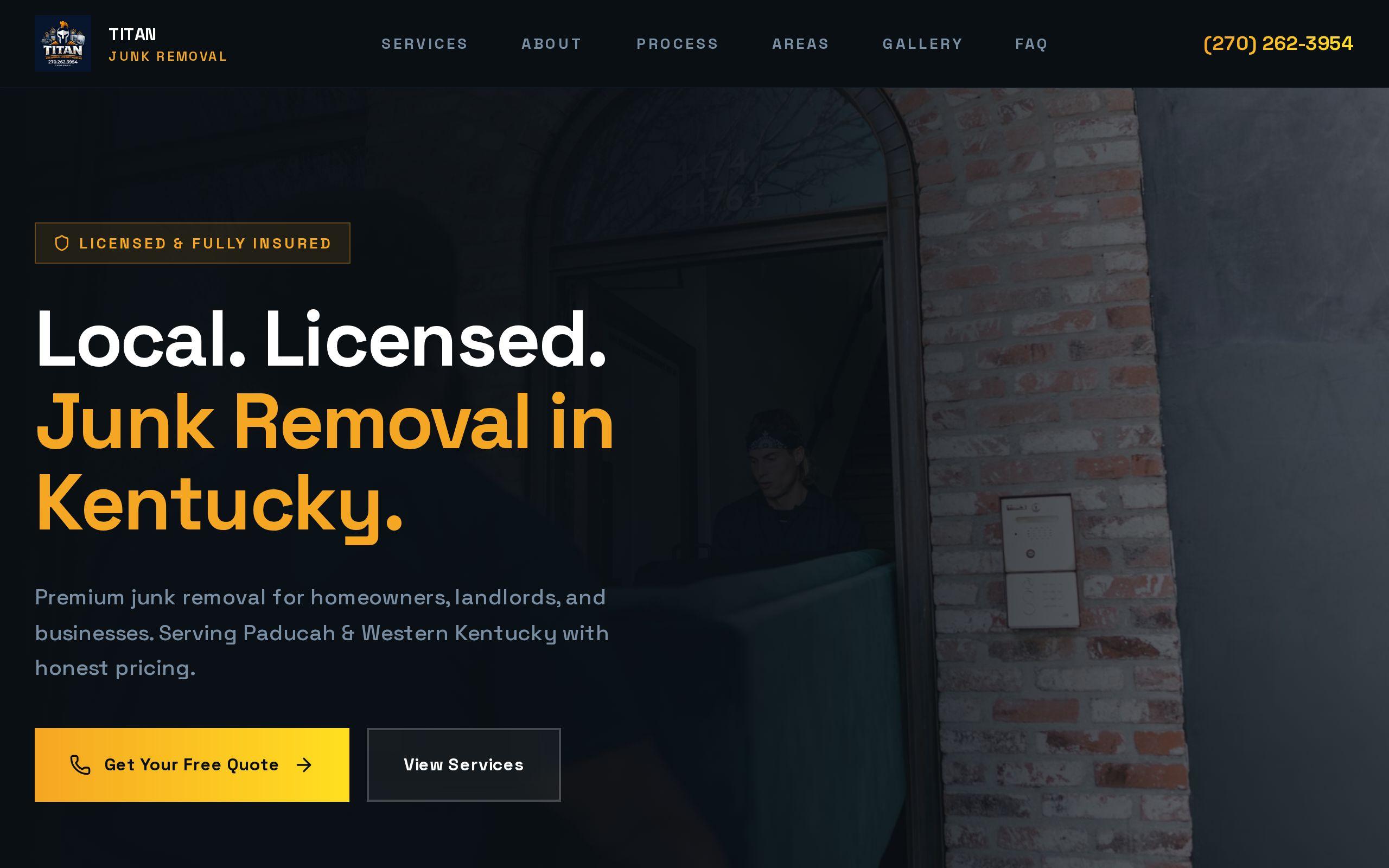
The Titan Junk Removal build is a good example of the smarter path. It is a family-owned operator that had to look substantial next to national brands. The answer was not imitation. We gave it a bold gold-on-dark identity that stays legible and distinctive in crowded local search results, so it reads as its own thing rather than a smaller copy of someone else.
Substantial means clear, confident and easy to act on. You can be all three at any size. You can see how that played out in the Titan Junk Removal case study.
How a click-to-call mobile layout wins the phone searcher
Think about the moment. Someone is standing in a garage full of things they want gone. They pull out a phone and call the first company that makes calling easy.
A desktop-shaped site with a contact form is the wrong tool for that moment. So Titan was designed mobile-first, with the phone screen as the primary layout rather than an adaptation of the desktop one. Click-to-call is the dominant action throughout, because that is how the category actually converts.
Check your own site on your own phone:
- Can you call within one tap, without scrolling?
- Does the number follow you down the page?
- Is the form optional, not the only door?
If the answer to any of those is no, a franchise with a clunky site may still beat you at the moment that counts. If you want a quick read on how your site holds up on a phone, run it through our speed test.
Build service-area pages that name the places you actually work
This is where the template falls apart, and where you can pull ahead.
Make one page for each area you serve. Not fifty near-duplicates. Only the places you really work, each one with its own content:
- The neighborhoods and nearby towns, by name.
- Jobs you have done there, with real photos.
- Details that only someone local would know, like access quirks, typical home types or local rules.
- Reviews from customers in that area.
- A clear phone number and a clear next step.
Titan was structured for local SEO specifically so it could compete with national franchises on home ground. That structure is the point. A page that exists because you work somewhere beats a page that exists because a template allowed it.
Make your Google Business Profile say what the franchise page cannot
For many local searches, the map pack comes first. Your Google Business Profile is how you earn a spot in it.
Treat it like a page on your site, not a form you filled out once:
- Pick the most accurate primary category, then add the secondary ones that apply.
- List every service you offer, in plain words.
- Set your service areas to the places you really work.
- Add fresh photos of real jobs, regularly.
- Ask every happy customer for a review, and reply to the ones you get.
Franchise listings tend to be managed from far away and say very little that is specific. Yours can name the work, the area and the people. Keep the name, address and phone number identical everywhere your business is listed.
What to do this month to close the gap
Do not try to fix everything. Pick these, in this order:
- Fix the phone experience. Put a tap-to-call button at the top of every page on mobile.
- Audit your profile. Fill in every field of your Google Business Profile and add recent photos.
- Write one real service-area page. Start with the town where you get the most calls.
- Ask for five reviews. Contact recent customers while the job is fresh.
That is a month of work, not a year. If you want help deciding where to start, our local SEO service covers exactly this, and you can tell us about your business any time.
Your next step today: search your main service in your own town, on your phone, and open the top franchise result. Then open your own site. Write down the three places yours loses. Start with the first one.