
Online estimate booking for a contractor website sounds like a feature. In practice it is a decision about what happens in the first sixty seconds after a homeowner decides to call you.
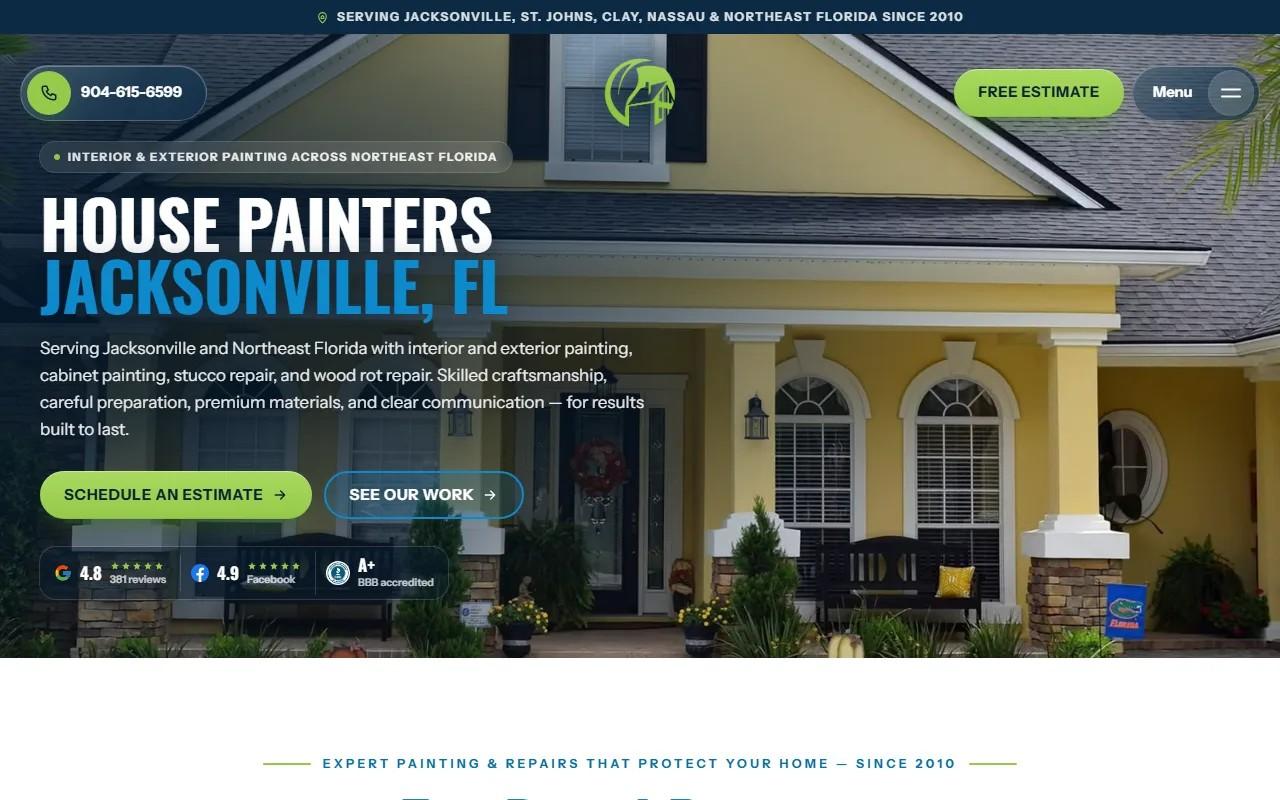
This is a look at that decision on one project. A New Leaf Painting Contractors paints homes and businesses across Jacksonville and Northeast Florida, and has since 2010. We rebuilt its site, and one piece of that work was the estimate form. The full project is in the A New Leaf Painting case study. Here we stay on the form.
What was wrong with how homeowners asked for an estimate?
Contractor sites tend to grow contact paths the way garages grow boxes. A phone number here. A contact page there. A button in the header, a different one on a service page, another at the bottom of a blog post.
Each one was added for a reason. Together they make a homeowner guess. Do I call? Fill out the long form? Wait, which button was the one that books something?
A New Leaf's site had grown for years, with hundreds of blog posts, paint guides, customer videos and a page for nearly every town the crews work in. Every one of those pages is a place a homeowner might decide to ask for an estimate. That is a lot of doors to leave in different states.
The owner, Thomas Drake, wanted booking an estimate to be simple. Simple meant fewer doors, not prettier ones.
Why did we make booking one form on the site itself?
Because the best moment to book is the moment the homeowner is already looking at your work.
Sending someone off to a third-party scheduler, or to a page that says "we will get back to you," adds a pause. Pauses are where homeowners open another tab and call the next painter.
So booking became one form, on the site itself. A homeowner does one of two things:
- Takes one of Thomas's real open times.
- Asks for a call.
That is the whole menu. No account to create, no maze of questions, no guessing which button counts.
If you are comparing options for your own site, this is the same thinking behind our contractor website design work. The site exists to get the estimate on the calendar.
How does a homeowner pick one of Thomas's real open times?
They see times that Thomas can actually do, and they pick one.
The word "real" carries the weight here. Most "request an estimate" forms are polite fiction. The homeowner types a message and hopes. Someone in the office reads it later, proposes a time, the homeowner replies, the office replies back. Four messages to arrive at a Tuesday.
An open time skips that. The homeowner is not asking whether Thomas is available. They are choosing from when he is.
Two things follow:
- The homeowner leaves the page with a commitment, not a hope.
- The office stops spending its mornings playing calendar ping-pong.
A homeowner who picked a time is also a better lead than one who typed "interested, please call." They have already decided something.
What if they would rather ask for a call?
Some people do not want to pick a slot. They want to talk first. Maybe the job is odd, maybe they have a question about an HOA, maybe they simply prefer a voice.
So the same form lets them ask for a call instead. That matters for a reason that is easy to miss: it keeps the second path inside the first one.
If "call me" lived on a separate page, you would be back to scattered contact paths. By putting both choices in one form, the office gets every request in the same shape, from the same place, whichever route the homeowner preferred.
Forcing people to book a slot would lose the ones who need a conversation. Offering only a call would lose the ones who want to be done in thirty seconds. One form, two honest options.
Why does every estimate link open the same window?
Every estimate link on the site opens the same window. The button in the header, the one on a town page, the one at the end of a blog post. Same window, same form, same two choices.
This is a small rule with a large payoff.
- The homeowner learns it once. After the first time, they know what every estimate button does.
- The page stays where it was. The window opens over what they were reading, so they do not lose their place or their train of thought.
- The office maintains one thing. Change the form once and every page on the site changes with it.
That last point matters more than it sounds. A site with hundreds of pages cannot afford a separate contact setup on each. The same instinct runs through the rest of this build, where every business fact comes from one source so hundreds of pages cannot drift out of agreement. One estimate window is the same idea applied to a button.
How does the request reach the follow-up system the office already ran?
It goes straight into the tool the office already used.
This was a deliberate choice, and it is the one we would defend hardest. A new booking form that sends leads to a new place is a trap. Somebody has to remember to check it. Somebody has to copy things over. Eventually somebody forgets, and the forgotten request is always the big job.
Thomas's office already had a follow-up system. Their habits, reminders and routines lived there. So the form feeds that system, and the office keeps working the way it works.
The lesson for any contractor: do not make your staff adopt a new tool because your website got better. Make the website adapt to the tool your staff already trusts. If your follow-up runs on automated emails and reminders, that is the kind of thing our email automations work is built around.
Why does the leads inbox store each request before passing it on?
Because passing a request along can fail, and a homeowner should never pay for that.
Behind the site we built an office for Thomas: a page builder, a media library, his own job pricer rebuilt as a screen, and a leads inbox. The leads inbox does one unglamorous thing well. When a request comes in, it stores it first. Then it passes it on to the follow-up system.
Order matters. Picture the reverse. The form sends the request straight to another system, that system is down for ten minutes, and the homeowner's request evaporates. Nobody knows it existed. The homeowner assumes you ignored them.
With the request stored first, there is always a record. If the handoff stumbles, the request is still sitting in the inbox, waiting to be passed along or picked up by hand.
This is plumbing, and nobody will ever compliment it. That is the point. You only notice it on the day it saves a job.
What would we tell another contractor to copy first?
Start with the doors, not the paint.
Count how many different ways a homeowner can ask you for an estimate today. Then pick one and make everything else lead to it. In order of what we would copy first:
- One form. Every estimate link opens it. Retire the rest.
- Real times. Offer the homeowner actual openings, with a call as the second choice.
- Your existing system. Deliver requests to the tool your office already checks.
- Store before you send. Keep a record of every request, so a failed handoff is a delay and not a loss.
None of this requires a redesign of how you paint, price or schedule. It requires deciding that the homeowner's first move should be obvious.
If you want to see how the rest of the site was rebuilt around that idea, the case study walks through it. And if you are not sure how your own site handles that first move, count the estimate buttons on your homepage tonight. The number you land on is your starting point.