
You have a folder of photos on your phone that most competitors would love to have. Finished decks. Repainted exteriors. Kitchens that went from tired to done. Right now those photos probably live in a camera roll and a few social posts.
They could be doing the hardest job in your local marketing. Here is how to put them to work in Raleigh and across the Triangle.
Why do homeowners judge a contractor on trust before price?
Because the contractor is about to walk through their house.
A homeowner hiring a painter or a remodeler is letting a stranger into the place they sleep. Price matters, but only after the person feels safe. Nobody compares quotes from someone they would not trust with a key.
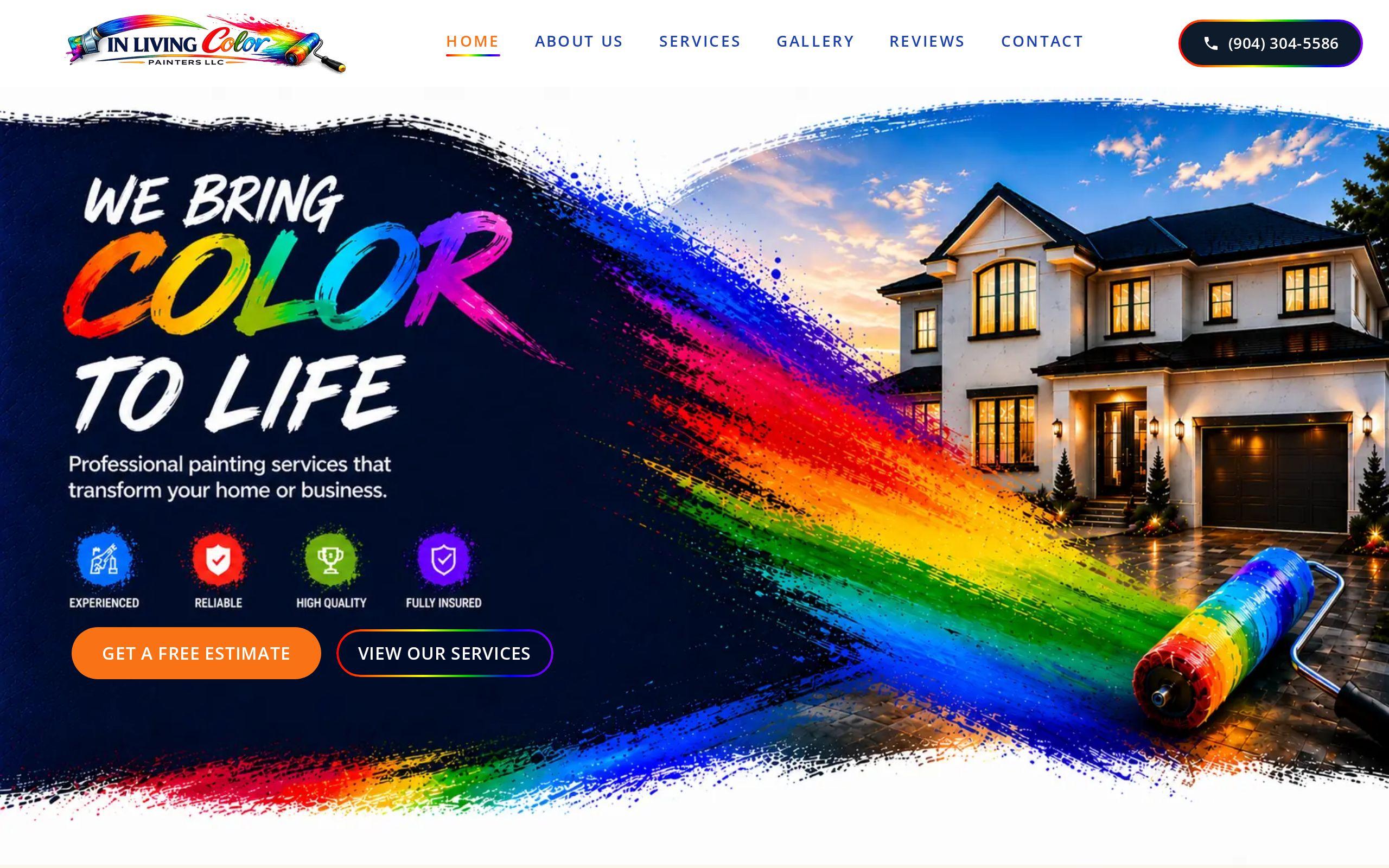
That is the starting point for every site we build in the trades. For In Living Color Painters, the whole brief rested on it: the buying decision is driven by trust far more than price. For Signature Home Solutions, the layouts were built trust-first, because home improvement buyers vet the contractor before they compare a price.
So the order of your website matters. Prove you are competent. Then make it easy to ask for a number.
How do finished-job photos help you rank locally?
Photos do not rank on their own. The page around them does.
What a strong photo gives you is a reason to build a real page. A page about a finished job has a place, a scope, a material and a result to write about. That is exactly the specific, local content a search engine looks for when someone types a service and "Raleigh" into the box.
It also does something a ranking report will never show. It convinces the person who lands there. A visitor who sees real work from a real job stays, scrolls and inquires. A visitor who sees stock photography leaves.
Most painting and remodeling sites lean on stock images and dated design. Real photography is the cheapest way to stand apart from them.
What makes a job photo worth publishing?
Not every photo earns a spot. Hold them to a short standard:
- It shows finished work. Mid-job mess belongs in a before-and-after, not alone.
- It is yours. Real crew, real house, real light. No stock.
- It is sharp and bright. Take it in daylight with the phone held level.
- It has context. Know the neighborhood, the type of job and what changed.
Then name it plainly. A file called exterior-repaint-north-raleigh.jpg tells a person and a search engine more than IMG_4471.jpg. Add a caption that says what was done in a sentence. Skip the keyword stuffing. If a neighbor would not talk that way, neither should the caption.
What should each service page say about the job and the place?
Each service gets its own page. Interior painting is not exterior painting. A bathroom remodel is not a deck.
A good service page answers four questions fast:
- What exactly do you do under this heading?
- Where do you do it? Name the Raleigh neighborhoods and nearby towns you actually serve.
- What does finished work look like? Put the photos here, high on the page.
- What happens next? Point to the estimate request.
Write the place into the copy the way a person would. "We repaint exteriors across Raleigh, Cary and Wake Forest" reads naturally. A paragraph that lists every zip code reads like a bot wrote it.
If a service is not offered in an area, do not claim it. Trust is the whole game.
How do you let homeowners find their specific job quickly?
Make them self-identify in a few seconds.
That was a core design goal for In Living Color Painters. Services are laid out so a homeowner can spot their own job at a glance, instead of reading a paragraph of everything the company does.
Signature Home Solutions faced a wider spread: small repairs on one end, whole-room remodels on the other. A catch-all list serves neither buyer. So the service range is organized so visitors find their specific job.
Do the same. Use clear names for each job, with one photo each. Group them in a way your customers think, not the way your invoices do. Someone with a leaky-faucet-sized problem and someone planning a full kitchen should each land in the right place within seconds.
This helps search too. Clear structure gives every job its own page to be found on.
Where should the estimate request sit on the page?
Everywhere. Not in a menu.
On Signature Home Solutions, the estimate request is the primary action on every page, not a destination buried in navigation. A booked estimate is the success metric, so the site is tuned around it.
On In Living Color Painters, the quote request flow is short enough to finish on a phone, one-handed. That is how most homeowners will do it: standing in the room they want painted, phone in one hand.
A few rules we would hold you to:
- Put a request button near the photos, where trust peaks.
- Ask only what you need to schedule a visit.
- Test the form on your own phone before you call it done.
- Let small jobs be quick. Do not make a repair feel like paperwork.
If your form needs a keyboard, a coffee and ten minutes, you are losing the jobs that were easiest to win.
How does your Google Business Profile support the same photos?
Your Google Business Profile is the other front door. For a lot of Raleigh homeowners it is the first one.
Use the same finished-job photos there. Add new ones when a job wraps. A profile with fresh, real work looks alive. A profile with a single logo and an old storefront shot looks abandoned.
Keep the details consistent with the website: business name, service area, phone number, services. Make sure the services listed on the profile match the service pages you built. When the listing and the site say the same thing, both become easier to trust.
Link the profile to the most relevant page, not just the home page. Someone searching for exterior painting should land on exterior painting. Our SEO and analytics work covers this wiring if you want a hand with it.
How do you ask happy customers for reviews after a job?
Ask on the day the job is finished, while the result is fresh and the customer is smiling at it.
Keep it simple:
- Ask in person first. "Would you mind sharing how it went on Google?" is enough.
- Send the link right away. A text with a direct link beats "find us online."
- Make it one tap. Every extra step costs you a review.
- Reply to every review. Thank people, and mention the job type when it fits.
Do not pay for reviews. Do not write them yourself. Do not only ask the customers you expect to be thrilled and skip the rest, because a profile that looks curated reads that way. Just ask everyone, every time. If you want a system around it, our reputation management service is built for exactly that.
What can a Raleigh contractor do this week?
Pick one job. Not ten.
- Choose your best recent finished job and gather five good photos.
- Rename the files and write a one-sentence caption for each.
- Put them on the matching service page, with the neighborhood named in the copy.
- Add an estimate button beside the photos and test it on your phone.
- Upload the same photos to your Google Business Profile.
- Text the customer a review link.
That is an afternoon. Do it again next week with the next job.
If you want to see how this plays out on a real build, look at the In Living Color Painters case study or the Signature Home Solutions case study. Then open your own camera roll and pick the first job.