
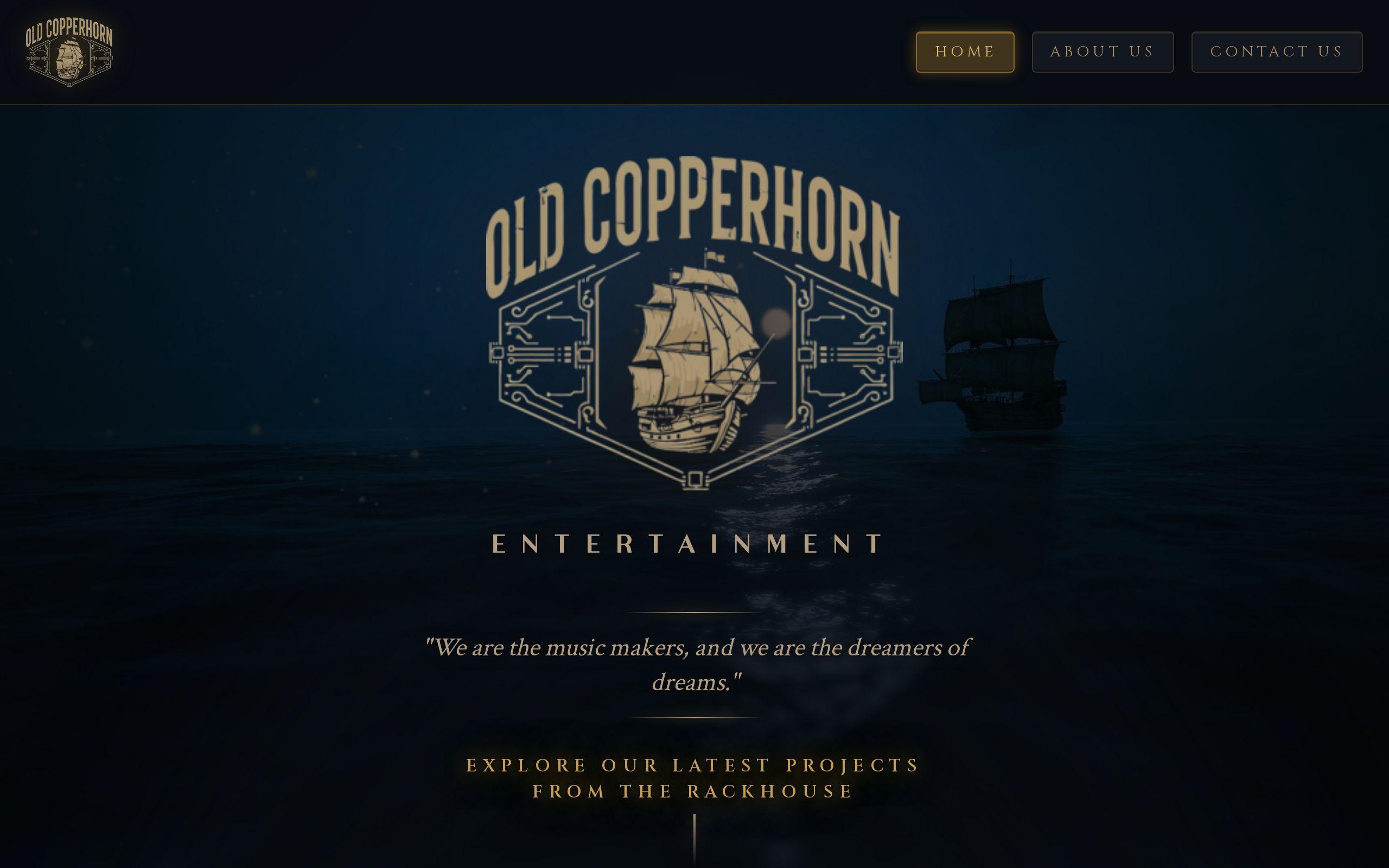
Old Copperhorn Entertainment came to us with a problem most studios never have to solve: nothing to show. No streaming deal signed. No comic on shelves. No trailer to embed. Just original IP in development and two audiences who needed to believe in it anyway. Here is how we built the site, and why the decisions hold up.
You can see the finished work at /portfolio/old-copperhorn-entertainment.
What Do You Sell When the Product Isn't Finished Yet?
Most entertainment sites lean on proof. A trailer, a release date, a "watch now" button. Old Copperhorn had none of that. The studio is building original franchise IP from the ground up, which means the site had to do something harder than showcase a product. It had to make a case for a studio that hasn't shipped anything yet.
That case can't be made with claims. Nobody believes "we're going to be great" from a company with no catalogue. It has to be made with craft. The site itself is the evidence. If the design, the writing, and the pacing feel like they came from people who know what they're doing, the visitor extends trust to the unfinished work behind it. If the site feels generic, no amount of copy about vision and ambition will save it.
That's the brief in one sentence: build a site good enough to stand in for the catalogue that doesn't exist yet.
Two Audiences, One Site: Industry Partners and Future Fans
Old Copperhorn isn't pitching one group. It's pitching two, at the same time, on the same pages.
Industry partners, financiers, distributors, potential collaborators, land on the site to answer one question: is this studio credible enough to bet on? They're scanning for professionalism, coherence, and evidence of a real operation, not enthusiasm.
Future fans land on the same site asking something different: is this world worth caring about? They want atmosphere, mood, a reason to come back when something actually launches.
Those two questions pull in different directions. Lean too hard into the industry pitch and the site reads like a deck, cold and forgettable to a fan. Lean too hard into fan-facing spectacle and it reads unfinished to a partner evaluating risk. We didn't build two sites or two paths. We built one structure that satisfies the credibility question and the curiosity question at once, because a studio that can do that convincingly is itself a signal of competence.
Why Atmosphere Became the Actual Product Being Sold
Once you accept that there's no finished catalogue to lead with, the next question is: what does lead?
For Old Copperhorn, the answer was atmosphere. Not screenshots of a product, because there isn't one. Not a features list, because entertainment IP doesn't have features. What it has is mood, tone, and a visual world that hints at what the finished properties will feel like.
We treated that atmosphere as the actual deliverable. Every page had to communicate the feeling of the Old Copperhorn universe before it communicated any facts about business plans or release timelines. That's a different design problem than most client sites present. Most sites are selling clarity: here's what we do, here's how to buy it. This site was selling immersion, and immersion has to be earned with restraint, pacing, and a visual language that doesn't explain itself so much as it sets a mood and lets the visitor sit in it.
How the Visual Language Had to Read as 'Studio,' Not 'Fan Page'
Here's the trap in entertainment web design: get the mood right and you risk looking like a fan wiki. Fan pages are full of atmosphere. They are also, almost without exception, unstructured, inconsistent, and amateur in their execution.
The line between "immersive" and "amateur" is discipline. A fan page throws in every piece of lore it can find. A studio site is edited. It shows restraint about what it reveals and when. It has a visual system, consistent typography, consistent spacing, a consistent way of introducing new material, rather than a pile of assets stitched together by enthusiasm.
We built Old Copperhorn's visual language to carry that discipline through every page. The goal wasn't to look impressive in isolation. It was to look like it came from an organization with a point of view and the process to execute on it consistently, which is exactly what an industry partner is trying to determine when they land on the site.
Building for Properties That Don't Exist Yet
A studio developing original franchise IP is, by definition, not done. Old Copperhorn is building across streaming, film, and comics, and today's site has to hold tomorrow's announcements without a rebuild.
That's an information architecture problem, not just a design one. If the site structure is built around today's specific properties, every new announcement forces a restructure. So we built the architecture around categories of work, the kinds of properties the studio makes, rather than a fixed list of named titles. A new streaming project or a new comic slots into a structure that already expects it.
That decision is part of the brand development work as much as the technical build, since the way a studio organizes its own output says something about how it thinks. We approached this the same way we approach brand development for any client: build the system now so growth later doesn't mean starting over.
What Old Copperhorn's Homepage Prioritizes First
Order matters more on a site like this than on almost any other kind of business site, because the homepage is doing the work a demo reel or a portfolio piece would do elsewhere.
The homepage leads with the brand and the worlds themselves, ahead of anything transactional. No early ask to contact, subscribe, or invest. The first job of the page is to establish that Old Copperhorn has a distinct identity, before it asks the visitor to do anything with that identity.
Only after that does the site start doing double duty, giving industry visitors the credibility signals they came for and giving future fans a reason to remember the name. That sequencing, brand first, function second, is the single biggest structural decision in the build, and it's the one most sites in this category get backwards by rushing to a call to action before they've earned the visitor's attention.
Why This Approach Would Fail for a Studio With a Finished Catalogue
It's worth being direct about the limits of this approach, because it isn't the right model for most entertainment or media businesses.
A studio with released titles, a production company with produced credits, a publisher with books on shelves, all of these have proof to lead with. For them, atmosphere-first design without a catalogue up front would be a mistake. It would bury the thing visitors actually came to verify. Those sites should lead with the work: titles, credits, release dates, watch or buy links, because the audience's question isn't "should I believe this studio has taste," it's "show me what you've made."
Old Copperhorn's approach works specifically because the studio had nothing finished to hide behind and nothing finished to lead with either. Atmosphere wasn't a stylistic choice. It was the only asset available that could do the job proof usually does.
What a Triangle Media or Entertainment Brand Can Take From This
If your Raleigh or Triangle-area business is building something before it can prove it, a production company in development, a game studio pre-launch, an agency building an original format, the lesson isn't "make it moody." It's this: figure out what's actually true and sellable about your business right now, even without a finished product, and build the site to prioritize that thing above everything else.
For Old Copperhorn, that was tone and credibility. For your business, it might be something else entirely. The exercise is the same regardless of industry, and it's one we do with every client at the start of a web design engagement, before a single page gets built.
If you're building something that isn't finished yet and need a site that can carry the weight until it is, get started with a conversation about what you actually have to sell today.