
Should you put prices on your website for AI search? Yes. Publish a starting-at number for every core service you sell.
That advice makes some owners flinch. Pricing feels like something you earn the right to discuss on a call. But the call is not where the question starts anymore.
Why do people ask AI assistants what something costs?
Because cost is the first thing a buyer wants to know and the last thing most websites will say.
Someone in Cary types "how much does a doula cost" or "what should a small business pay for a marketing agency" into ChatGPT or Google. They get one tidy answer instead of ten tabs. That is the whole appeal.
The question is a filter. The buyer is deciding whether this is a thing they can afford before they bother with names. If your business cannot be placed on that map, you are not on the shortlist.
What happens when your website has no prices?
The assistant still answers. It just answers without you.
It fills the gap with what it can find. That might be a directory listing, a three-year-old review, a national average, or a competitor's page. None of those know your packages.
So the buyer gets a number, and it is not yours. Maybe it is too low, and they arrive annoyed. Maybe it is too high, and they never arrive.
A blank pricing page does not keep your options open. It hands the framing to someone else.
What does starting-at pricing give an AI answer to quote?
A fact with your name on it.
"Starts at" is the right phrase. It is true for everyone, it commits you to nothing you cannot deliver, and it is exactly the shape of sentence an assistant likes to repeat: "Packages from this company start at X."
Compare that with a page that says "contact us for a custom quote." There is nothing in that sentence to quote. The assistant moves on to a business that gave it something.
You do not need a full rate card. You need one honest floor per service, written in a sentence a stranger could read aloud.
How did BodyWise Birth Co. handle pricing for three services?
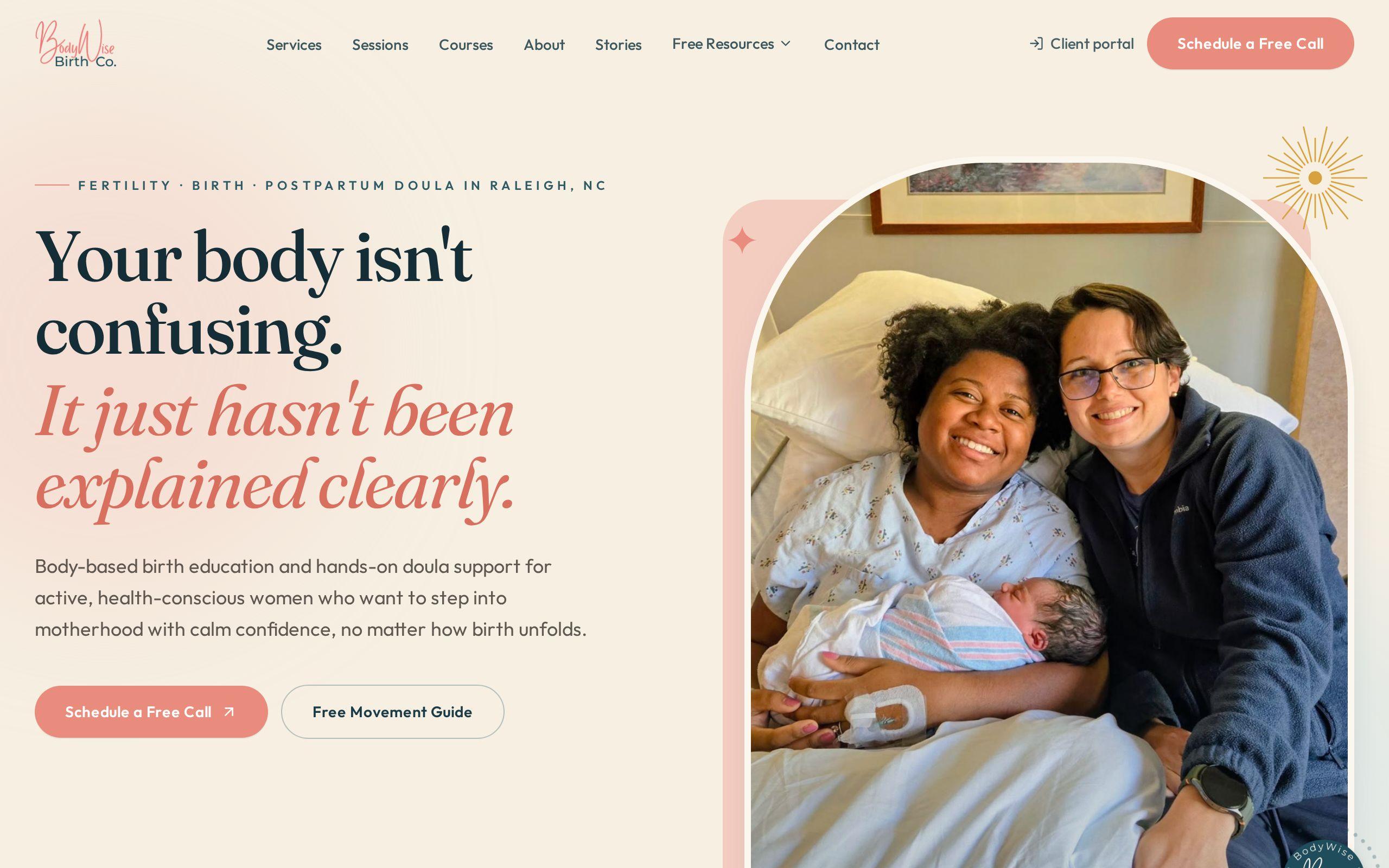
BodyWise is a Raleigh doula practice that spans fertility charting, birth support and postpartum recovery. Three services, three different customers.
A doula is also selling trust to someone at a vulnerable moment, before they have met. Hiding the price would have added one more unknown to a decision that already has plenty.
So the site we built shows a starting-point price for each package. It sits inside three clear paths, education, pregnancy and birth, and postpartum, so a visitor finds their own door without reading the other two.
The goal was simple: remove the uncertainty that keeps families from reaching out at all. You can see the full build in the BodyWise Birth Co. case study.
Why do pricing tiers help buyers qualify themselves?
Tiers answer the question "is this for someone like me?" before anyone picks up a phone.
The Social Boot is a digital marketing agency, and its own site had a tricky brief. It needed to be direct about price, which most agencies avoid. Vague pricing filters out exactly the self-serve buyers it wanted.
So the site publishes clear tiers. Prospects qualify themselves before the first conversation, and the booking sits right on the site for those who do. Read how it came together in the Social Boot case study.
QuestBlue, a cloud communications company, did the same for a harder reason. Its buyers compare providers line by line. Transparent tiers let them place QuestBlue against competitors on the spot.
Is it a risk that competitors can see your prices?
Less than you think. They can call you pretending to be a customer today.
The real risk runs the other way. A buyer who cannot find your price assumes the worst, or assumes you are not for them, and the assistant that answered for them had nothing of yours to cite.
Published prices also do quiet work on the wrong-fit inquiry. The person who would never have paid your rate reads the number and leaves. That is a conversation you did not have to spend an hour on.
What if your prices vary too much to publish?
Publish the variables instead.
Not every business can name a single floor. A custom project depends on scope. Fine. Give the reader three things:
- A realistic range, or a minimum engagement size.
- The two or three factors that move the price up or down.
- One described example: what a typical project includes and roughly where it lands.
That is still something an assistant can quote and a buyer can plan around. "Projects usually start at X and grow with Y and Z" beats "it depends" every time.
Only publish numbers you would honor. A range you will not stand behind is worse than none.
How do you format pricing so it is easy to read and extract?
Plain text, near the service it describes, with the number next to the name.
A few habits that help people and machines alike:
- Use real text. A price baked into an image or a PDF is hard to read for an assistant and miserable on a phone.
- Name each package and its price in one line. "Postpartum support, starting at X" works. A table that needs three clicks does not.
- Say what is included. A number with no scope is easy to misquote.
- Keep one page per service where you can. Price, scope and next step in the same place.
For tiers, a short comparison list beats a wall of features. If your site is fighting you on structure, that is a web development conversation, not a copywriting one.
How do you keep published prices accurate over time?
Treat the price like inventory. It has an owner and a review date.
Wrong prices are worse than none. A quoted number that is stale gets repeated, and then you are explaining an old rate to a new customer.
A simple routine covers it:
- Pick one person who owns every price on the site.
- Review them on a fixed schedule, such as when you change your own rates and once each quarter regardless.
- Search your site for each number so no old figure hides in a blog post or a PDF.
- Add "starting at" and, where it helps, a "last reviewed" note.
Assistants refresh slowly and unevenly, so a fix you make today may take a while to show up. That is one more reason to get the number right the first time.
What should you do this week?
Open your site and try to find what your main service costs. Time yourself.
If you cannot find it in under a minute, a buyer, or an assistant answering for one, cannot either. Write one honest starting-at line for each core service and put it where the service is described.
Not sure where yours should go? Tell us about your site and we will point to the page where a price would do the most work.