
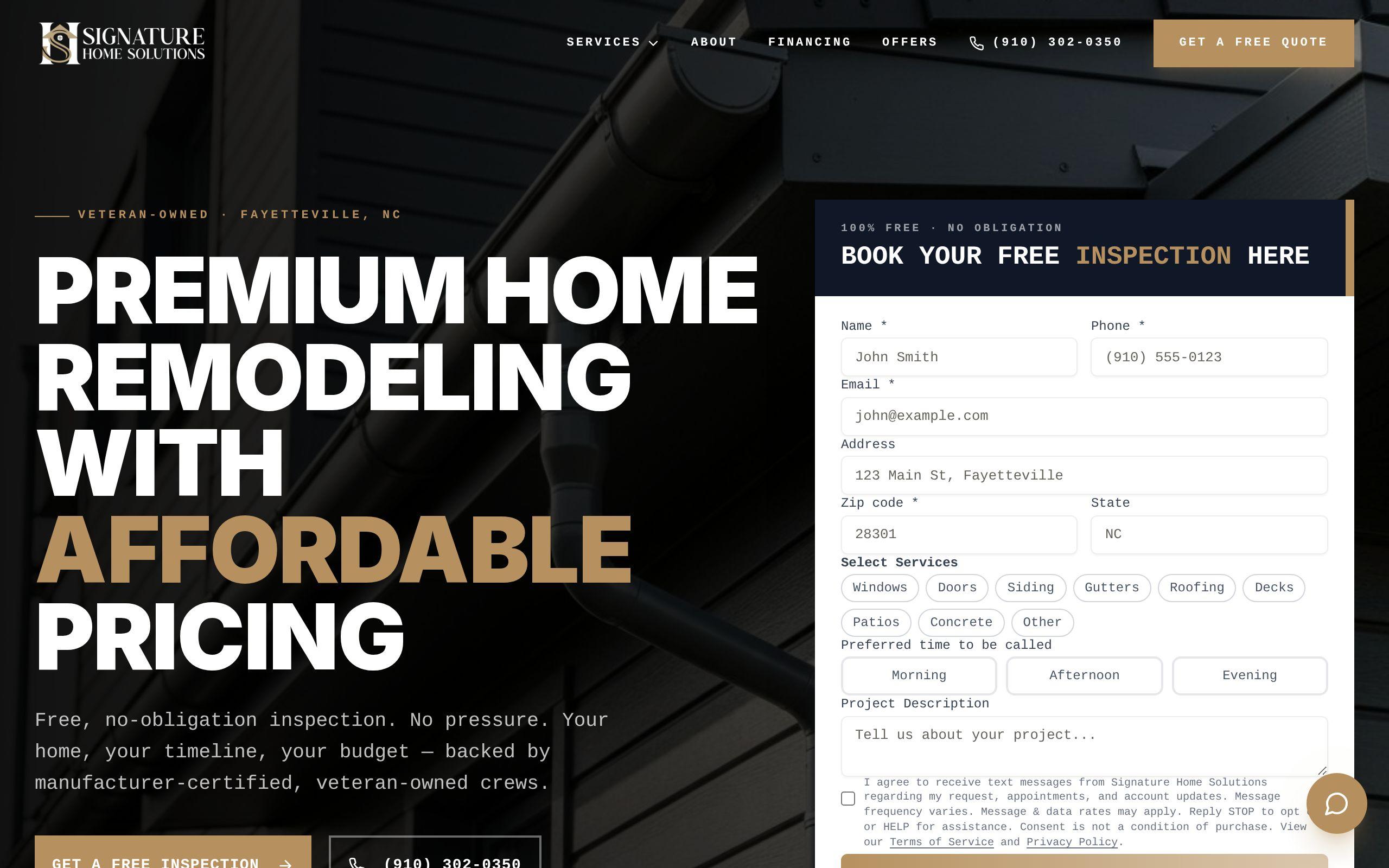
Most home improvement companies sell a wider range than their website admits. A leaky faucet and a full kitchen remodel might both come through the same phone number, but they are not the same sale. They are not even the same buyer.
Signature Home Solutions is a full-service home improvement company that does exactly this: small repairs on one end, whole-room remodels on the other. When they came to Forzur, their site treated every inquiry the same way. One contact form, one generic pitch, one tone. That works for nobody in particular.
Here is how we rebuilt it, and why.
The brief: one company, wildly different job sizes
The problem was not that Signature Home Solutions lacked traffic or credibility. It was that their site asked every visitor to do the same amount of work before they'd get an answer, regardless of what they actually needed.
Think about the two ends of that spectrum. A homeowner with a broken cabinet hinge wants a fast answer and a low-commitment way to ask for one. A homeowner planning a full bathroom remodel expects to be asked more, because the job is bigger and the stakes are higher. Hand the repair customer a long, detailed intake form and they bounce. Hand the remodel customer a bare "contact us" box and they wonder if the company takes big jobs seriously.
A single generic contact page serves neither buyer well. The site needed a structure that could route a wide range of inquiries into one estimate pipeline, without making the small jobs feel like paperwork or the large jobs feel unconsidered.
That's the design problem in one sentence: one company, one pipeline, many buyers.
Organizing services so visitors can find their specific job
The first move was to stop asking visitors to read a catch-all list and start letting them find their own job. We organized the service range so a homeowner looking for a repair lands somewhere that speaks to repairs, and a homeowner planning a remodel lands somewhere that speaks to remodels.
This sounds simple. It is also the part most home improvement sites skip, usually because it's easier to list every service on one page than to build out the structure behind it. But structure is what does the work here. When a visitor can self-identify their job in the first few seconds on the site, they stop evaluating whether this company is relevant to them and start evaluating whether this company is the right one to hire. That's a faster, warmer path to an estimate request.
We treated this as an information architecture problem first and a visual design problem second. Good navigation for a company like Signature Home Solutions isn't about looking clean. It's about making sure a visitor never has to guess which part of the site applies to them.
Making the estimate request the primary action on every page
Once visitors can find their job, the next question is what they do next. On the old site, the path to actually requesting an estimate was buried in navigation, the kind of thing you have to go hunting for. That's a real cost. A visitor who is ready to ask for an estimate and can't find how to do it easily doesn't keep looking. They leave and call the next name on their list.
So we made the estimate request the primary action on every page, not a destination tucked into a menu. Wherever someone lands, whatever job they're looking at, the next step is obvious and close at hand.
This matters more in home improvement than in a lot of other categories, because buyers move at very different speeds. Some are ready the moment they land on the site. Others are still comparing options and will come back later. A primary action available everywhere serves both. The ready buyer converts immediately. The comparing buyer sees, repeatedly, that asking is easy, which lowers the barrier when they're ready to act.
You can see the full build, including how the service pages and the estimate flow work together, on the case study page.
Designing trust-first for a category won on vetting, not price
Home improvement is not a category where the lowest number wins. It's a category where the homeowner is inviting someone into their house, often for days at a time, and they know it. Before a buyer compares a price, they are vetting a contractor: are these people who show up, who do the job right, who won't leave a mess and a headache behind.
That changes what belongs near the top of the page. A site that leads with pricing or a bare service list is answering a question the buyer hasn't asked yet. The buyer's first question is whether this company can be trusted with their home. So we built the layouts trust-first, putting the material that answers "can I trust this company" ahead of the material that answers "what will this cost."
This is also why the estimate request itself matters as a trust signal, not just a conversion mechanism. A request for an estimate is a lower-commitment ask than "call us" or "buy now." It fits how a home improvement buyer actually decides: gather information, request pricing, then choose. The site's job is to make each of those steps feel like the natural next one, not a hurdle.
The result: one pipeline built for conversion volume
Every decision on this site points at the same outcome: a booked estimate. Not a form fill, not a page view. An actual estimate request that a homeowner meant to send.
That's a deliberate choice about what "success" means for a site like this. It would be easy to build a home improvement site that looks good and generates a trickle of vague inquiries. It's harder, and more useful to the business, to build one where the service structure, the primary action, and the trust content all work together to move visitors toward a specific, qualified next step, regardless of whether they came in looking for a repair or a remodel.
That's what makes this a conversion project as much as a design project. The service organization gets the right visitor to the right page. The persistent estimate request gets them to act while they're still interested. The trust-first layout gives them a reason to believe this is the company to hire before price ever enters the conversation. One pipeline, handling the full range of the business, without asking any single buyer to do more than their job actually requires.
If your business sells across a wide range of job sizes and your site still funnels everyone into one generic contact form, that mismatch is costing you estimates you should be winning. Our custom web development work is built around exactly this kind of routing problem. Start with a free consultation, or if you want a quick read on how your current site is performing, run it through our speed test first.