
If you tutor in Raleigh, Cary, or anywhere else in the Triangle, you already know the hard part is not the hour with the child. It is what happens at 6 p.m., when a parent wonders whether the money is working. This is how we built that moment for Moore Prep, a one-teacher practice in Wake Forest. If you are searching for how tutors write progress reports for parents, this is one answer, from the inside.
Why does the note home matter more than the session?
A parent is not in the room. They hand over a child who is struggling, and they get back a kid who says "it was fine."
So the note is the session, as far as the parent can tell. It is the only proof that someone noticed something specific about their child. A vague note says "we worked on reading." A good note says what moved, what is still hard, and what happens next.
That makes the follow-up the product. Not the booking page, not the price list. Those get a family in the door. The note is what they tell other parents about.
What was the brief?
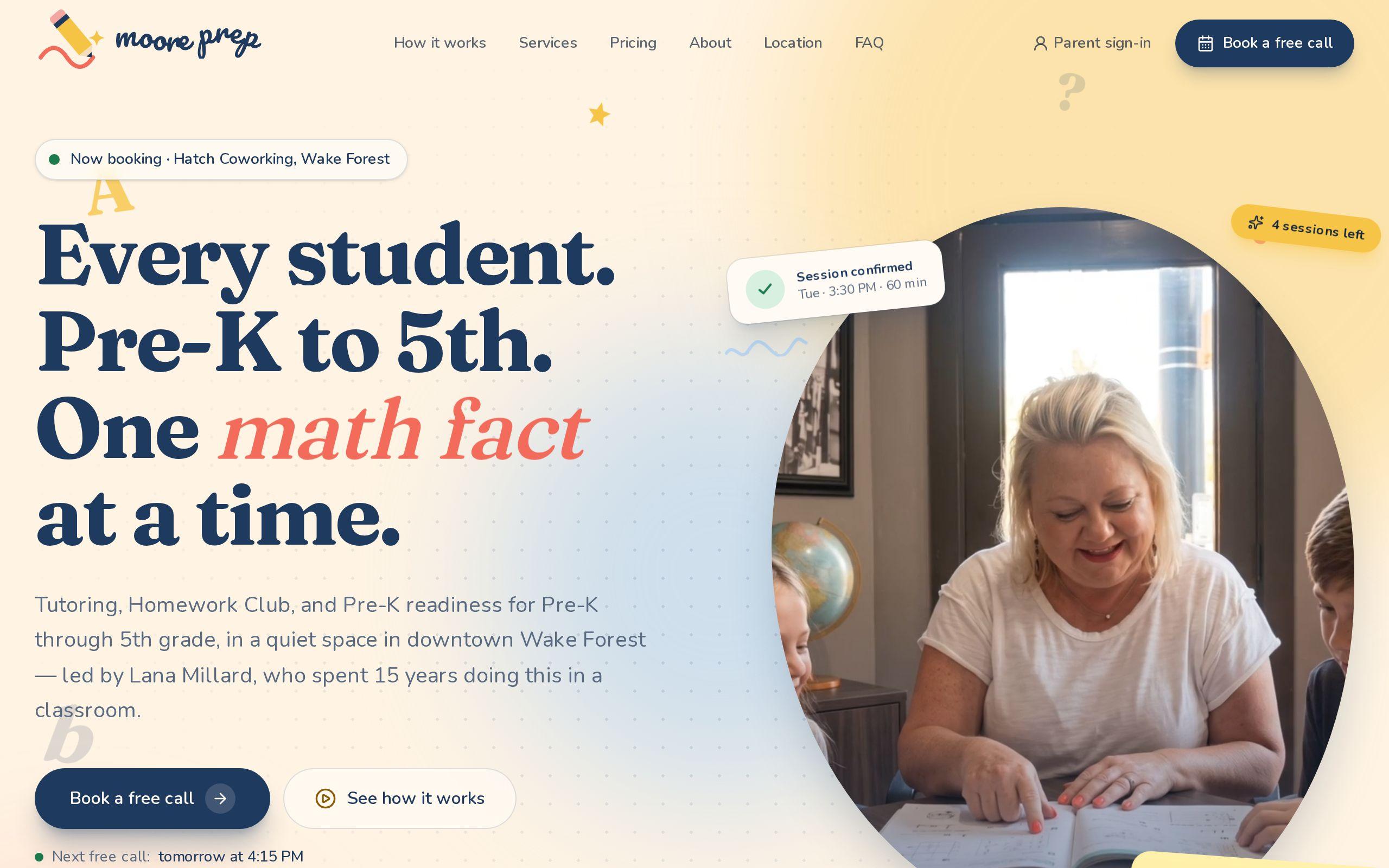
Moore Prep is one educator, Lana Millard, working with children in a small room at Hatch Coworking in downtown Wake Forest. Behind that quiet room, one person handles scheduling, payments, cancellations, reminders, and notes home.
Most practices juggle those across a booking app, a payment link, a spreadsheet, and a text thread. The notes are usually the first thing to slip, because they come last, after a full day, when nobody has energy left.
The brief was to build around exactly that person. No staff to delegate to. No time to write three paragraphs after every session. You can see the full build on the Moore Prep case study.
Why does every child get goals first?
A note needs something to measure against. Without goals, every note starts from nothing and drifts into pleasantries.
In the Moore Prep system, every child has goals. They sit in the back office next to the child, not in a separate document no one opens. When Lana records a session, the goals are already there.
That changes what a note can say. Instead of "good session," the note can speak to the thing the family and the teacher agreed mattered. Progress becomes visible because the target was written down first.
This is the cheapest idea in the whole system, and the one a solo tutor can copy tomorrow.
How does the session assistant turn dictation into a draft?
Lana's day runs on her phone. The back office is phone-first, with Today, the calendar, requests, payments, the waitlist, and messages.
After a session she can dictate her notes out loud or type them. Rough is fine. Half sentences are fine. The session assistant turns that into a draft note home.
The point is the blank page. Writing from nothing is slow. Editing a decent draft is fast. The assistant does the slow part and leaves the judgment part to the person who was in the room.
If you want to see how we think about this kind of tool for small businesses, our AI and automation work starts from the same idea: take the dull step, keep the human decision.
Why is nothing sent until the tutor edits it?
Because the note carries Lana's name.
A parent reading it is trusting a stranger with a struggling child. One wrong detail, one tone-deaf phrase about a hard day, and that trust takes a hit. A draft cannot know that a child cried at minute forty, or that a parent is going through something at home.
So the draft goes to Lana, and she edits it. Only then does it go home. There is no auto-send, no "approve all" shortcut.
Our position is simple. For a one-teacher practice, a tool that sends on its own is a liability. A tool that drafts and waits is a good assistant.
What can a parent share with a classroom teacher?
Parents often want the school to know what is happening at tutoring. Usually they forward texts or try to summarize from memory.
Moore Prep gives each child a progress report a family can share with a classroom teacher by private link. The parent decides who gets it. The teacher gets a clean record instead of a screenshot.
That does something useful for the child. The person teaching them all day and the person teaching them after school are finally looking at the same picture.
It also quietly markets the practice. A classroom teacher who sees a clear, specific report from a tutor tends to remember who sent it.
What is the year statement for?
Tutoring is a real expense, and some families can use it for taxes or benefits accounts. Come January, they need paperwork.
Moore Prep gives families a year statement for exactly that. Under the hood, every family's sessions sit on an append-only ledger, so purchases, bookings, cancellations, and refunds always add up. The statement draws on records that already reconcile.
This is unglamorous work, and parents notice it anyway. Nobody has to email Lana in January asking for a receipt. One less chore for her, one less awkward ask for them.
What can a solo tutor copy this month without custom software?
Most of this works with tools you already have. Start here:
- Write goals for each child. Two or three lines, in a folder per child, before the next session.
- Dictate right after the session. Use your phone's voice memo or dictation. Two minutes, rough is fine.
- Keep a note template. What we worked on, what moved, what is hard, what is next.
- Edit before you send. Always. Read it as the parent would.
- Save a running summary per child. When a parent asks for something to share with school, you already have it.
- Keep a simple record of payments by year. January goes easier.
Custom software earns its place when volume and complexity grow. Moore Prep needed it because the notes, ledger, portal, and reports all had to talk to each other. You might not yet.
Your next step
This week, open a blank page for each child you tutor and write their goals in two lines. Then dictate your next session's notes within five minutes of the child leaving. If you want a site and system built around your practice the way this one was, start at get started, or look at how we approach tutoring website design.